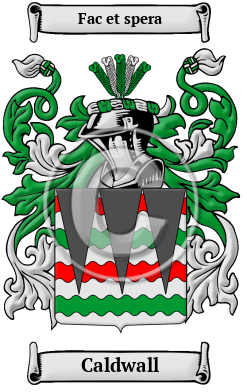
| ![Show Contents]() Caldwall History, Family Crest & Coats of Arms Caldwall History, Family Crest & Coats of Arms
- Origins Available:
Scotland
Ireland
Etymology of CaldwallWhat does the name Caldwall mean? Scottish history reveals Caldwall was first used as a surname by the Strathclyde-Briton people. It was a name for someone who lived in Renfrewshire. This place-name may also be derived from the Old English words caeld, which means cold, and welle, which means well, and indicates that the original bearer lived near a well that gave cold water. 1 Early Origins of the Caldwall familyThe surname Caldwall was first found in Renfrewshire (Gaelic: Siorrachd Rinn Friù), a historic county of Scotland, today encompassing the Council Areas of Renfrew, East Renfrewshire, and Iverclyde, in the Strathclyde region of southwestern Scotland, at the Caldwell Tower, a mansion and old estate that dates back to 1294. 2 The current Caldwell Tower stands on a mound, and is a small, free-standing tower that was probably built in the 16th century. It was fully restored in 2011 with the addition of a small extension. Caldwell is also a village and civil parish in the Richmondshire district of North Yorkshire. "The old family of the name appears to have ended in the direct line in an heiress in the fifteenth century. In 1342 there is an entry of the fee of William de Caldwell. Robert Cauldwell was a merchant in the service of Sir John of Montgomery, 1405." 3 The Caudle variant may be related to a thickened and sweetened alcoholic hot drink so named. It was popular in the Middle Ages for its supposed medicinal properties and dates back to at least 1297. Further to the south in the English county of Yorkshire, the Yorkshire Poll Tax Rolls of 1379 listed: Johannes de Coldwell; and Thomas de Coldwele. 4 Early History of the Caldwall familyThis web page shows only a small excerpt of our Caldwall research. Another 175 words (12 lines of text) covering the years 1419, 1495, 1505, 1526, 1533, 1548, 1551, 1554, 1559, 1561, 1572, 1581, 1584, 1596, 1628, 1661, 1679, 1687, 1796, 1890 and 1929 are included under the topic Early Caldwall History in all our PDF Extended History products and printed products wherever possible. Caldwall Spelling VariationsIt is only in the last few hundred years that rules have developed and the process of spelling according to sound has been abandoned. Scottish names from before that time tend to appear under many different spelling variations. Caldwall has been spelled Caldwell, Coldwell, Caldwill, Cauldwell, Cauldwill, Cawldwell, Guildwell, Calewell, Caldewell and many more. Early Notables of the Caldwall family- Richard Caldwall (1505?-1584), was an English physician, born in Staffordshire about 1505. "He was educated at Brasenose, graduated as B.A. in 1533, and became a fellow, but afterwards moved to Christ...
Migration of the Caldwall family to IrelandSome of the Caldwall family moved to Ireland, but this topic is not covered in this excerpt.
Another 61 words (4 lines of text) about their life in Ireland is included in all our PDF Extended History products and printed products wherever possible.
| Caldwall migration to the United States | + |
Unwelcome in their beloved homeland, many Scots sailed for the colonies of North America. There, they found land and freedom, and even the opportunity to make a new nation in the American War of Independence. These Scottish settlers played essential roles in the founding of the United States, and the shaping of contemporary North America. Among them:
Caldwall Settlers in United States in the 18th Century- David Caldwall, who landed in Philadelphia, Pennsylvania in 1740 5
- George Caldwall, who arrived in Philadelphia, Pennsylvania in 1740 5
- Jane Caldwall, who landed in Philadelphia, Pennsylvania in 1740 5
- John Caldwall, who arrived in Philadelphia, Pennsylvania in 1740 5
- Mary Caldwall, who landed in Philadelphia, Pennsylvania in 1740 5
Caldwall Settlers in United States in the 19th Century- William Caldwall, who arrived in New York in 1833 5
| Contemporary Notables of the name Caldwall (post 1700) | + |
- James Caldwall (b. 1739), English designer and engraver, born in London in 1739, a pupil of Sherwin 6
The motto was originally a war cry or slogan. Mottoes first began to be shown with arms in the 14th and 15th centuries, but were not in general use until the 17th century. Thus the oldest coats of arms generally do not include a motto. Mottoes seldom form part of the grant of arms: Under most heraldic authorities, a motto is an optional component of the coat of arms, and can be added to or changed at will; many families have chosen not to display a motto.
Motto: Fac et spera
Motto Translation: Do and hope.
- Harrison, Henry, Surnames of the United Kingdom: A Concise Etymological Dictionary Baltimore: Geneological Publishing Company, 2013. Print
- Lewis, Samuel, A Topographical Dictionary of Scotland. Institute of Historical Research, 1848, Print.
- Black, George F., The Surnames of Scotland Their Origin, Meaning and History. New York: New York Public Library, 1946. Print. (ISBN 0-87104-172-3)
- Bardsley, C.W, A Dictionary of English and Welsh Surnames: With Special American Instances. Wiltshire: Heraldry Today, 1901. Print. (ISBN 0-900455-44-6)
- Filby, P. William, Meyer, Mary K., Passenger and immigration lists index : a guide to published arrival records of about 500,000 passengers who came to the United States and Canada in the seventeenth, eighteenth, and nineteenth centuries. 1982-1985 Cumulated Supplements in Four Volumes Detroit, Mich. : Gale Research Co., 1985, Print (ISBN 0-8103-1795-8)
- Wikisource contributors. "Dictionary of National Biography, 1885-1900." Wikisource . Wikisource , 4 Jun. 2018. Web. 31 Oct. 2019
 |