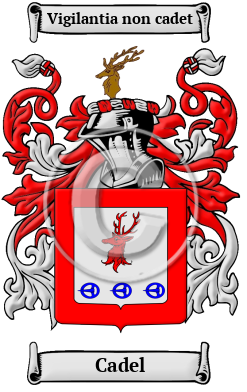
| ![Show Contents]() Cadel History, Family Crest & Coats of Arms Cadel History, Family Crest & Coats of Arms
Etymology of CadelWhat does the name Cadel mean? The story of the Cadel family begins in ancient Scotland among the Pictish clans. The Cadel family lived at or near the wooded stream derived from the Gaelic word coillie, a wood and dur which means stream. Early Origins of the Cadel familyThe surname Cadel was first found in Banffshire (Gaelic: Siorrachd Bhanbh), former Scottish county located in the northeasterly Grampian region of Scotland, now of divided between the Council Areas of Moray and Aberdeenshire. One source notes, "the northern Cawdors were disguised as Cadells and de Cadella even in old Scots chroniclers, and they have kept that variety permanently in the South. " 1 Further to the south in England, the Hundredorum Rolls of 1273 listed: Cristina Caudel, Cambridgeshire; William Caudel, Cambridgeshire; and (Prior) de Caudewelle, Bedfordshire. 2 "Cadel was a surname in Oxfordshire and Sussex at the close of the 13th century." 3 Cadell (d. 909), was "King of Ceredigion and afterwards of Powys, one of the six warlike sons of Rhodri Mawr, the most powerful of the early Welsh kings. He was Rhodri's eldest son, and received as his patrimony Ceredigion, with the palace at Dinevwr, and an overlordship over his other brothers. " 4 Cadell (d. 943), was a Welsh prince, the son of Arthvael, who was the son of Hywel. Cadell (d. 1175), was a South Welsh prince, the son of Gruffudd, the son of Rhys, the son of Tewdwr. 4 Early History of the Cadel familyThis web page shows only a small excerpt of our Cadel research. Another 179 words (13 lines of text) covering the years 1530, 1536, 1558 and 1600 are included under the topic Early Cadel History in all our PDF Extended History products and printed products wherever possible. Cadel Spelling VariationsTranslation has done much to alter the appearance of many Scottish names. It was a haphazard process that lacked a basic system of rules. Spelling variations were a common result of this process. Cadel has appeared Cadell, Caddell, Cadel, Cadwell and others. Early Notables of the Cadel family Migration of the Cadel family to IrelandSome of the Cadel family moved to Ireland, but this topic is not covered in this excerpt. More information about their life in Ireland is included in all our PDF Extended History products and printed products wherever possible. Migration of the Cadel familyMany Scots left their country to travel to the North American colonies in search of the freedom they could not find at home. Of those who survived the difficult voyage, many found the freedom they so desired. There they could choose their own beliefs and allegiances. Some became United Empire Loyalists and others fought in the American War of Independence. The Clan societies and highland games that have sprung up in the last century have allowed many of these disparate Scots to recover their collective national identity. A search of immigration and passenger ship lists revealed many early settlers bearing the Cadel name: John Cadell who settled in Barbados in 1654; another John arrived in New York in 1774; Elizabeth Cadell arrived in New England in 1767; Albert Cadwell, aged 36, who arrived at Ellis Island, in 1921.
The motto was originally a war cry or slogan. Mottoes first began to be shown with arms in the 14th and 15th centuries, but were not in general use until the 17th century. Thus the oldest coats of arms generally do not include a motto. Mottoes seldom form part of the grant of arms: Under most heraldic authorities, a motto is an optional component of the coat of arms, and can be added to or changed at will; many families have chosen not to display a motto.
Motto: Vigilantia non cadet
Motto Translation: Vigilance will not miscarry.
- Black, George F., The Surnames of Scotland Their Origin, Meaning and History. New York: New York Public Library, 1946. Print. (ISBN 0-87104-172-3)
- Bardsley, C.W, A Dictionary of English and Welsh Surnames: With Special American Instances. Wiltshire: Heraldry Today, 1901. Print. (ISBN 0-900455-44-6)
- Guppy, Henry Brougham, Homes of Family Names in Great Britain. 1890. Print.
- Smith, George (ed), Dictionary of National Biography. London: Smith, Elder & Co., 1885-1900. Print
 |