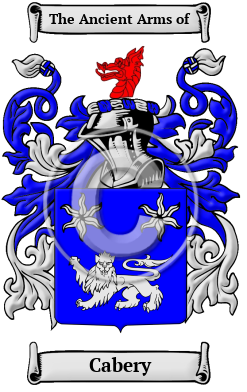
| ![Show Contents]() Cabery History, Family Crest & Coats of Arms Cabery History, Family Crest & Coats of Arms
Etymology of CaberyWhat does the name Cabery mean? The name Cabery was first used by the ancient Strathclyde-Briton people of the Scottish/English Borderlands. The first Cabery to use this name no doubt lived in the parish of Inveresk, Lothian, which was first recorded in the form Crebarrin, from the words Gaelic craobhm meaning "tree," and barran, meaning "hedge." Early Origins of the Cabery familyThe surname Cabery was first found in Midlothian, from the lands of CarBerry in the parish of Inveresk. "Johannes de Crebarrin filius Gilleberti de Crebarrin made two grants of lands from his territory of Crebarrin, c. 1230, and about the same period Adam filius Patricii de Crebarrin gifted four bovates of his land of Crebarrin to the Abbey of Dunfermelin. Alexander Crabarri, juror on forfeited estates in Lothian, 1312. William Carbery, M.A., petitioned for a canonry of Aberdeen, 1406." 1 CarBerry Tower is a historic house in East Lothian, Scotland. King David I of Scotland granted "Caerbairin" (Carberry) to the monks of Dunfermline Abbey. The first landowner or lessee was John de Crebarrie. CarBerry Hill, part of the CarBerry Estate was the site where Mary, Queen of Scots facing an army assembled by a confederation of her lords, surrendered. While most of the family hails from Scotland, there is another possible origin; that of Ireland. There the name "is derived from a geographical locality, 'of CarBerry,' a parish in County Kildare, Ireland. As this surname looks very English, I insert it to prevent any misapprehension." 2 "The Carbury or Carbery baronies in Longford and Sligo were so called from Cairbre, one of the sons of Niall of the Nine Hostages, King of Ireland from A.D. 379 to 405." 3 4 Early History of the Cabery familyThis web page shows only a small excerpt of our Cabery research. Another 131 words (9 lines of text) covering the years 1230, 1743, 1792, 1806 and 1890 are included under the topic Early Cabery History in all our PDF Extended History products and printed products wherever possible. Cabery Spelling VariationsScribes in Medieval Scotland spelled names by sound rather than any set of rules, so an enormous number of spelling variations exist in names of that era. Cabery has been spelled CarBerry, Carbarry, Carbery, Carbray, Carbury, Carbrey, Carbry, Carby, Crebarin and many more. Early Notables of the Cabery familyMore information is included under the topic Early Cabery Notables in all our PDF Extended History products and printed products wherever possible. Migration of the Cabery family to IrelandSome of the Cabery family moved to Ireland, but this topic is not covered in this excerpt.
Another 57 words (4 lines of text) about their life in Ireland is included in all our PDF Extended History products and printed products wherever possible. Migration of the Cabery familyThe number of Strathclyde Clan families sailing for North America increased steadily as the persecution continued. In the colonies, they could find not only freedom from the iron hand of the English government, but land to settle on. The American War of Independence allowed many of these settlers to prove their independence, while some chose to go to Canada as United Empire Loyalists. Scots played essential roles in the forging of both great nations. Among them: Edward, James, John, Patrick, William CarBerry arrived in Philadelphia between 1840 and 1855; John Carbery arrived in New York 1803; Cormick Carbey arrived in Philadelphia in 1864..
- Black, George F., The Surnames of Scotland Their Origin, Meaning and History. New York: New York Public Library, 1946. Print. (ISBN 0-87104-172-3)
- Bardsley, C.W, A Dictionary of English and Welsh Surnames: With Special American Instances. Wiltshire: Heraldry Today, 1901. Print. (ISBN 0-900455-44-6)
- Harrison, Henry, Surnames of the United Kingdom: A Concise Etymological Dictionary Baltimore: Geneological Publishing Company, 2013. Print
- MacLysaght, Edward, More Irish Families. Dublin: Irish Academic Press, 1982. Print. (ISBN 0-7165-0126-0)
 |