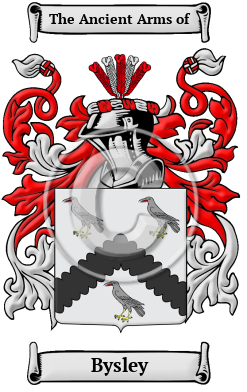
| ![Show Contents]() Bysley History, Family Crest & Coats of Arms Bysley History, Family Crest & Coats of Arms
- Origins Available:
England
Etymology of BysleyWhat does the name Bysley mean? The surname Bysley is derived from the large village named Bisley in Surrey. The village's name was first recorded in the 10th century as 'Busseleghe' when it was derived from the old English words 'Bysc', meaning bushes, and 'Leah', a clearing. In more modern terms, the name means 'clearing where bushes grow.' Bisley is also a village in Gloucestershire, but this latter village was established after the Surrey local. Finally, Bisley is also a game of solitaire we cannot determine if the surname is related. Early Origins of the Bysley familyThe surname Bysley was first found in Berkshire, where they held a family seat as Lords of the Manor. After the Battle of Hastings in 1066, William, Duke of Normandy, having prevailed over King Harold, granted most of Britain to his many victorious Barons. It was not uncommon to find a Baron, or a Bishop, with 60 or more Lordships scattered throughout the country. These he gave to his sons, nephews and other junior lines of his family and they became known as under-tenants. They adopted the Norman system of surnames which identified the under-tenant with his holdings so as to distinguish him from the senior stem of the family. After many rebellious wars between his Barons, Duke William, commissioned a census of all England to determine in 1086, settling once and for all, who held which land. He called the census the Domesday Book, 1 indicating that those holders registered would hold the land until the end of time. Hence, conjecturally, the surname is descended from the tenant of the lands of Leofric of Abingdon who was recorded in the Domesday Book census of 1086. Early History of the Bysley familyThis web page shows only a small excerpt of our Bysley research. Another 114 words (8 lines of text) covering the years 1180, 1483, 1510 and 1600 are included under the topic Early Bysley History in all our PDF Extended History products and printed products wherever possible. Bysley Spelling VariationsEndless spelling variations are a prevailing characteristic of Norman surnames. Old and Middle English lacked any definite spelling rules, and the introduction of Norman French added an unfamiliar ingredient to the English linguistic stew. French and Latin, the languages of the court, also influenced spellings. Finally, Medieval scribes generally spelled words according to how they sounded, so one person was often referred to by different spellings in different documents. The name has been spelled Bisley, Bisley, Bissley, Bysley and others. Early Notables of the Bysley familyMore information is included under the topic Early Bysley Notables in all our PDF Extended History products and printed products wherever possible. Migration of the Bysley familyTo escape the political and religious persecution within England at the time, many English families left for the various British colonies abroad. The voyage was extremely difficult, though, and the cramped, dank ships caused many to arrive in the New World diseased and starving. But for those who made it, the trip was most often worth it. Many of the families who arrived went on to make valuable contributions to the emerging nations of Canada and the United States. An inquiry into the early roots of North American families reveals a number of immigrants bearing the name Bysley or a variant listed above: Wm. Bisley, who came to Virginia in 1618; Francis Bisley, who settled in Virginia in 1637; and Alexander Bisley, who arrived in New York in 1714.
- Williams, Dr Ann. And G.H. Martin, Eds., Domesday Book A Complete Translation. London: Penguin, 1992. Print. (ISBN 0-141-00523-8)
 |