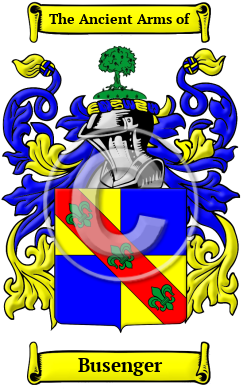
| ![Show Contents]() Busenger History, Family Crest & Coats of Arms Busenger History, Family Crest & Coats of Arms
- Origins Available:
England
Etymology of BusengerWhat does the name Busenger mean? The ancient Anglo-Saxon surname Busenger came from the German name Beringar which meant "bear-spear." The name was "one of the paladins in the Charlemagne romances and fairly common in England in the 12th and 13th centuries." 1 Early Origins of the Busenger familyThe surname Busenger was first found in the Domesday Book of 1086, where the Latin form Berengerus was recorded in Norfolk. 2 Later in Lincolnshire, Robertus filius Berengarii was listed c. 1150 and in Bedfordshire, the singular name Bengerus was found in the Curia Regis Rolls of 1203. The first record in Dorset was that of Belinar in 1207. Early Yorkshire records show Berenger faber in the Assize Rolls for 1219. Walter Beneger was found in Gloucestershire in 1208 and Reginald Beringer was listed at Lewes, Cambridgeshire c. 1260. John Belinger was listed in the Subsidy Rolls for Worcestershire in 1275. 1 Early History of the Busenger familyThis web page shows only a small excerpt of our Busenger research. Another 257 words (18 lines of text) covering the years 1086, 1150, 1271, 1273, 1275, 1500, 1694, 1780 and 1831 are included under the topic Early Busenger History in all our PDF Extended History products and printed products wherever possible. Busenger Spelling VariationsOne relatively recent invention that did much to standardize English spelling was the printing press. However, before its invention even the most literate people recorded their names according to sound rather than spelling. The spelling variations under which the name Busenger has appeared include Berringer, Berenger, Baringer, Beringar, Berengerus, Berengarus, Berengarii, Beringer, Belinger, Bellinger, Bellenger, Beranger and many more. Early Notables of the Busenger familyMore information is included under the topic Early Busenger Notables in all our PDF Extended History products and printed products wherever possible. Migration of the Busenger familyAt this time, the shores of the New World beckoned many English families that felt that the social climate in England was oppressive and lacked opportunity for change. Thousands left England at great expense in ships that were overcrowded and full of disease. A great portion of these settlers never survived the journey and even a greater number arrived sick, starving, and without a penny. The survivors, however, were often greeted with greater opportunity than they could have experienced back home. These English settlers made significant contributions to those colonies that would eventually become the United States and Canada. An examination of early immigration records and passenger ship lists revealed that people bearing the name Busenger arrived in North America very early: Peter Berringer who arrived in Philadelphia in 1751.
- Reaney, P.H and R.M. Wilson, A Dictionary of English Surnames. London: Routledge, 1991. Print. (ISBN 0-415-05737-X)
- Williams, Dr Ann. And G.H. Martin, Eds., Domesday Book A Complete Translation. London: Penguin, 1992. Print. (ISBN 0-141-00523-8)
 |