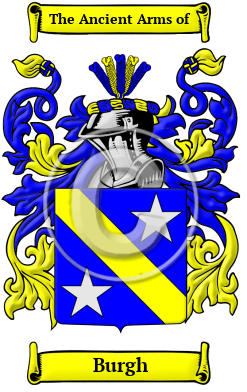
| ![Show Contents]() Burgh History, Family Crest & Coats of Arms Burgh History, Family Crest & Coats of Arms
Etymology of BurghWhat does the name Burgh mean? The ancient German region of the Rhineland, gave birth to the family name of Burgh. At first, people used only a single name, but as the population grew and people began to travel, they began to find it necessary to take on an additional name to differentiate themselves. Fairly general principles guided the development of hereditary surnames in the Rhineland. Among the most common forms of surname found in the Rhineland are those that are derived from nicknames. Nickname surnames were derived from an "eke-name" or added name. They usually reflected the physical characteristics or attributes of the first person that used the name. The name was derived from the German word "burc," which means a "fortified town." The surname Burgh was a name for a person who lived in a town. Early Origins of the Burgh familyThe surname Burgh was first found in the Rhineland, where this family name became a prominent contributor to the development of the district from ancient times. Always prominent in social affairs, the name became an integral part of that turbulent region as it emerged to form alliances with other families within the Feudal System and the nation. Early History of the Burgh familyThis web page shows only a small excerpt of our Burgh research. Another 144 words (10 lines of text) covering the years 1100, 1540, 1550, 1556, 1573, 1579, 1589, 1599, 1716, 1763, 1765, 1834 and 1842 are included under the topic Early Burgh History in all our PDF Extended History products and printed products wherever possible. Burgh Spelling VariationsMany cultural groups lived in the German states in medieval times. Each had its own dialect and traditions, and unique variations of popular names. Low German, which is similar to contemporary Dutch, was spoken in Westphalia. German names are characterized by additions such as regional suffixes and phrases that tell something about the origin or background of its original bearer. Further contributing to the variation in German names was the fact that there were no spelling rules in medieval times: scribes recorded names according to their sound. The recorded spelling variations of Burgh include Berg, Bergh, Berghe, Bergg, Berge, Bergge, Burg, Burgh and many more. Early Notables of the Burgh familyAdam Berg, a renowned music printer of Munich, whose publications extend from 1540 to about 1599. His great work was the 'Patrocinium musices,' published under the patronage of the Dukes of Bavaria, the first volume of which appeared in 1573. After the death of Duke Albrecht V, in 1579, the publication was interrupted, and not resumed till 1589, when the second series appeared, also containing five volumes. 1
George Berg, a German by birth, was a pupil of Dr. Pepusch. In 1763 he gained the first prize medal awarded by the Catch Club for his glee 'On softest beds...
Another 97 words (7 lines of text) are included under the topic Early Burgh Notables in all our PDF Extended History products and printed products wherever possible.
| Burgh migration to the United States | + |
Between the 17th and 20th centuries, hundreds of thousands of Europeans came to North America, and many Rhinelanders were among them. They had many various reasons for making the choice: to escape poverty and persecution, for adventure, and for the opportunity to own their own land. Ellis Island, one of the main American immigration centers, saw many settlers as they moved on to the states of Pennsylvania, Ohio, Texas, Illinois, California, and New York. In Canada, they found homes in Ontario, and on the great plains of the Midwestern provinces. The Burgh were among of the early German families that came to North America:
Burgh Settlers in United States in the 18th Century- John Burgh, who arrived in Virginia in 1705 2
Burgh Settlers in United States in the 19th Century- Samuel Burgh, aged 22, British settler who arrived in New York aboard the ship "Princess Charlotte" in 1830 3
- J. Burgh, aged 47, British settler who arrived in New York aboard the ship "Hudson" in 1832 3
- Francis Burgh, aged 34, British settler who arrived in New York aboard the ship "Philadelphia" in 1840 3
- George Burgh, aged 7, British settler who arrived in New York aboard the ship "Philadelphia" in 1840 3
- Sarah Burgh, aged 28, British settler who arrived in New York aboard the ship "Jane" in 1840 3
- ... (More are available in all our PDF Extended History products and printed products wherever possible.)
| Burgh migration to Australia | + |
Burgh Settlers in Australia in the 19th Century- Miss Eliza Burgh, (b. 1816), aged 25, British house maid who was convicted in Gloucestershire, England for 10 years for house breaking, transported aboard the "Garland Grove" on 14th June 1841, arriving in Tasmania (Van Diemen's Land) 4
- Eliza Burgh, aged 40, who arrived in South Australia in 1849 aboard the ship "William Money" 5
- Miss Letitia Burgh (Bird), (b. 1830), aged 20, English nursemaid, from Essex travelling from London aboard the ship "Slains Castle" arriving in Melbourne, Victoria, Australia on 25th January 1851 6
Burgh Settlers in Australia in the 20th Century- L. Burgh, British settler who arrived in Fremantle, Australia aboard the ship "Ophir" in 1909
- Vander Burgh, settler who arrived in Western Australia aboard the ship "Malwa" in 1913
- Miss Annette E. Burgh, British settler who arrived in Fremantle, Australia aboard the ship "Chitral" in 1928
| Contemporary Notables of the name Burgh (post 1700) | + |
- General Sir Eric de Burgh KCB, DSO, OBE (1881-1973), British Indian Army officer, served as Chief of the General Staff in India from 1939 to 1941
- Ulick Canning de Burgh (1827-1867), Lord Dunkellin, Anglo-Irish soldier and politician, was Military Secretary to the Viceroy of India and MP for Galway Borough (1857-65) and County Galway (1865-67)
- Walter de Burgh (1210-1271), 1st Earl of Ulster, 2nd Lord of Connaught, also spelt Burke or Bourke, Irish peer from the House of Burgh
- William de Burgh (1160-1205), British-born Irish founder of the House of Burgh (later surnamed Burke or Bourke) in Ireland
- Sir William Óg de Burgh (b. 1270), Anglo-Irish noble and soldier
- William de Burgh (1312-1333), 3rd Earl of Ulster and 4th Baron of Connaught, Irish noble who was Lieutenant of Ireland (1331)
- William de Burgh (1741-1808), prominent Anglo-Irish politician and theological writer and politician
- William George de Burgh FBA (1866-1943), English philosopher
- William Edward de Burgh (1863-1902), Irish clergman
- ... (Another 40 notables are available in all our PDF Extended History products and printed products wherever possible.)
- Grove, Sir George, A Dictionary of Music and Musicians (AD. 1450-1889) London: Macmillan1902, Print, 2 Vols
- Filby, P. William, Meyer, Mary K., Passenger and immigration lists index : a guide to published arrival records of about 500,000 passengers who came to the United States and Canada in the seventeenth, eighteenth, and nineteenth centuries. 1982-1985 Cumulated Supplements in Four Volumes Detroit, Mich. : Gale Research Co., 1985, Print (ISBN 0-8103-1795-8)
- Ellis Island Search retrieved 21st October 2021. Retrieved from https://heritage.statueofliberty.org/passenger-result
- Convict Records Voyages to Australia (Retrieved 24th October 2022). https://convictrecords.com.au
- State Records of South Australia. (Retrieved 2010, November 5) "WILLIAM MONEY" 1848-49. Retrieved from http://www.slsa.sa.gov.au/BSA/1849WmMoney.htm
- The Argus News Paper 27th January 1852 Page 2 (Retrieved 26th April 2019). Retrieved from https://trove.nla.gov.au/newspaper/article/4775844?browse=ndp%3Abrowse%2Ftitle%2FA%2Ftitle%2F13%2F1851%2F01%2F27%2Fpage%2F505154%2Farticle%2F4775844
 |