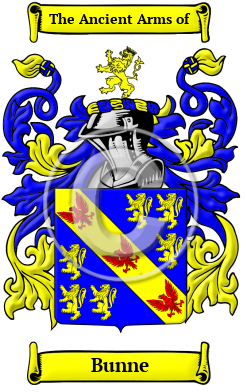
| ![Show Contents]() Bunne History, Family Crest & Coats of Arms Bunne History, Family Crest & Coats of Arms
- Origins Available:
England
Etymology of BunneWhat does the name Bunne mean? Bunne is a name of Anglo-Saxon origin. It was a name given to a person who was of good character. It originally derived from the Old French as le bon which was used as a term of endearment. The surname was adopted in England after the Norman Conquest of 1066. 1 Early Origins of the Bunne familyThe surname Bunne was first found in Oxfordshire, where Edward le Bon was recorded in the Curia Regis Rolls for 1204. In Wiltshire, the first record there was that of Rocelin le Bun who appeared in the Hundredorum Rolls of 1255. Walter le Bone was listed in the Subsidy Rolls for Sussex in 1296 and Thomas Bonne was found in Herefordshire in 1379. 2 Walter Buns was listed in the Hundredorum Rolls of 1273 in Oxfordshire. The Yorkshire Poll Tax Rolls of 1379 included Rogerus Bonne; and Johannes Bunne. 3 Early History of the Bunne familyThis web page shows only a small excerpt of our Bunne research. Another 229 words (16 lines of text) covering the years 1204, 1255, 1296, 1379, 1500, 1618, 1788, 1796, 1823, 1826, 1830, 1833, 1840 and 1860 are included under the topic Early Bunne History in all our PDF Extended History products and printed products wherever possible. Bunne Spelling VariationsBefore the last few hundred years, the English language had no fast system of spelling rules. For that reason, spelling variations are commonly found in early Anglo-Saxon surnames. Over the years, many variations of the name Bunne were recorded, including Bunn, Bun, Bon, Bonn, Bone, Bonne, Bunne and others. Early Notables of the Bunne familyAlfred Bunn (1796-1860), a prominent theatrical figure who served as joint manager of the Drury Lane and Covent Garden theatres in London in the 1830s. Elliston gave him his first appointment as stage-manager of Drury Lane in 1823, when he was quite a young man; and he first obtained a certain celebrity as a manager by endeavouring some dozen years afterwards to establish an English Opera. In 1826 he was manager of the Birmingham Theatre, and in 1833 held the same post at Drury Lane and Covent Garden. For most of these operas Mr. Bunn himself furnished the libretto, which however...
Another 101 words (7 lines of text) are included under the topic Early Bunne Notables in all our PDF Extended History products and printed products wherever possible.
| Bunne migration to the United States | + |
To escape oppression and starvation at that time, many English families left for the "open frontiers" of the New World with all its perceived opportunities. In droves people migrated to the many British colonies, those in North America in particular, paying high rates for passages in cramped, unsafe ships. Although many of the settlers did not make the long passage alive, those who did see the shores of North America perceived great opportunities before them. Many of the families that came from England went on to make essential contributions to the emerging nations of Canada and the United States. Research into various historical records revealed some of first members of the Bunne family emigrate to North America:
Bunne Settlers in United States in the 17th Century- John Bunne, who landed in Maryland in 1663 4
Bunne Settlers in United States in the 19th Century- J F Bunne, who arrived in San Francisco, California in 1851 4
- Charles R Bunne, who landed in Mississippi in 1854 4
- Lower, Mark Anthony, Patronymica Britannica, A Dictionary of Family Names of the United Kingdom. London: John Russel Smith, 1860. Print.
- Reaney, P.H and R.M. Wilson, A Dictionary of English Surnames. London: Routledge, 1991. Print. (ISBN 0-415-05737-X)
- Bardsley, C.W, A Dictionary of English and Welsh Surnames: With Special American Instances. Wiltshire: Heraldry Today, 1901. Print. (ISBN 0-900455-44-6)
- Filby, P. William, Meyer, Mary K., Passenger and immigration lists index : a guide to published arrival records of about 500,000 passengers who came to the United States and Canada in the seventeenth, eighteenth, and nineteenth centuries. 1982-1985 Cumulated Supplements in Four Volumes Detroit, Mich. : Gale Research Co., 1985, Print (ISBN 0-8103-1795-8)
 |