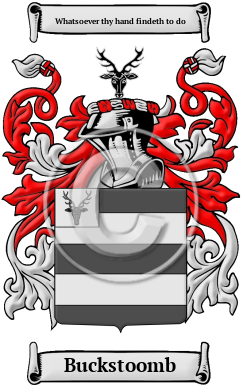
The origins of the Buckstoomb name lie with England's ancient Anglo-Saxon culture. It comes from when the family lived in the region of Buxton parishes in the diocese of Southwell and Norwich. It may also be derived from the town in Derbyshire where in Old English it was known as Buchestanes, meaning bowing stones.
Loading...
Early Origins of the Buckstoomb family
The surname Buckstoomb was first found in Derbyshire. However, the parish of Rushford in Suffolk was of particular significance to the family. "Schadwell Park, the seat of the family of Buxton, is a handsome mansion in the Elizabethan style, recently new fronted with Caen stone, and considerably enlarged; the park is richly wooded, and in the grounds is St. Chad's Well, anciently much frequented by pilgrims on their route to the shrine of Our Lady of Walsingham. The living is in the patronage of the Buxton family." 1
Early History of the Buckstoomb family
This web page shows only a small excerpt of our Buckstoomb research. Another 117 words (8 lines of text) covering the years 1400, 1562, 1588 and 1929 are included under the topic Early Buckstoomb History in all our PDF Extended History products and printed products wherever possible.
Buckstoomb Spelling Variations
Before the last few hundred years, the English language had no fast system of spelling rules. For that reason, spelling variations are commonly found in early Anglo-Saxon surnames. Over the years, many variations of the name Buckstoomb were recorded, including Buckston, Buxton, Buckstone and others.
Early Notables of the Buckstoomb family
Another 30 words (2 lines of text) are included under the topic Early Buckstoomb Notables in all our PDF Extended History products and printed products wherever possible.
Loading...
Loading...
Loading...
Loading...
Migration of the Buckstoomb family
To escape oppression and starvation at that time, many English families left for the "open frontiers" of the New World with all its perceived opportunities. In droves people migrated to the many British colonies, those in North America in particular, paying high rates for passages in cramped, unsafe ships. Although many of the settlers did not make the long passage alive, those who did see the shores of North America perceived great opportunities before them. Many of the families that came from England went on to make essential contributions to the emerging nations of Canada and the United States. Research into various historical records revealed some of first members of the Buckstoomb family emigrate to North America: Elizabeth Buxton who settled in Potomac Maryland in 1729; Grace Buxton settled in west New Jersey in 1773; John settled in Virginia in 1637; Robert in Virginia in 1646.
The motto was originally a war cry or slogan. Mottoes first began to be shown with arms in the 14th and 15th centuries, but were not in general use until the 17th century. Thus the oldest coats of arms generally do not include a motto. Mottoes seldom form part of the grant of arms: Under most heraldic authorities, a motto is an optional component of the coat of arms, and can be added to or changed at will; many families have chosen not to display a motto.
Motto: Whatsoever thy hand findeth to do
Sources
+
Lewis, Samuel, A Topographical Dictionary of England. Institute of Historical Research, 1848, Print.
Remove Item
WARNING!
Removing this item from your shopping cart will remove your associated sale items.
Are you sure you want to delete this item from your shopping cart?
HouseofNames E-Newsletter Sign Up
On Demand Gifts | Digital Products Available 24/7
A Gift for Everyone on your List is a Click Away - Shop Now