| ![Show Contents]() Brims History, Family Crest & Coats of Arms Brims History, Family Crest & Coats of Arms
- Origins Available:
England
Etymology of BrimsWhat does the name Brims mean? The name Brims is of Anglo-Saxon origin and came from when the family lived in Gloucestershire, where they held the manor and lands of Breme in the village and parish of that name. 1 It is from the manorial name from which the family name is derived. The name Brims means fierce, or vigorous. 2 Early Origins of the Brims familyThe surname Brims was first found in the Domesday Book of 1086 where the singular name Breme was recorded in Suffolk. 3 Later, Hugo Brem was found in the Assize Rolls for Warwickshire in 1221 and Simon Brim was listed in the Hundredorum Rolls of 1279 in Cambridgeshire. Again in Cambridgeshire, we found Agatha Breme in the Subsidy Rolls for 1327 and in the same year, Robert Brymme was listed in the Subsidy Rolls for Sussex. 2 Early History of the Brims familyThis web page shows only a small excerpt of our Brims research. Another 81 words (6 lines of text) are included under the topic Early Brims History in all our PDF Extended History products and printed products wherever possible. Brims Spelling VariationsIt is only in the last few hundred years that the English language has been standardized. For that reason, early Anglo-Saxon surnames like Brims are characterized by many spelling variations. As the English language changed and incorporated elements of other European languages, even literate people changed the spelling of their names. Scribes and monks in the Middle Ages spelled names they sounded, so it is common to find several variations that refer to a single person. The variations of the name Brims include: Breame, Bream, Breme and others. Early Notables of the Brims familyMore information is included under the topic Early Brims Notables in all our PDF Extended History products and printed products wherever possible.
| Brims migration to Australia | + |
Brims Settlers in Australia in the 19th Century- Alexander Brims, who arrived in South Australia in 1855 aboard the ship "Northern Light" 4
| Brims migration to New Zealand | + |
Emigration to New Zealand followed in the footsteps of the European explorers, such as Captain Cook (1769-70): first came sealers, whalers, missionaries, and traders. By 1838, the British New Zealand Company had begun buying land from the Maori tribes, and selling it to settlers, and, after the Treaty of Waitangi in 1840, many British families set out on the arduous six month journey from Britain to Aotearoa to start a new life. Early immigrants include: Brims Settlers in New Zealand in the 19th Century- George Brims, who arrived in Nelson, New Zealand aboard the ship "Bombay" in 1842 5
| Contemporary Notables of the name Brims (post 1700) | + |
- Lieutenant General Robin Vaughan Brims CB, CBE, DSO,, British Army officer, Commander of the Field Army at Land Command from 2005 to 2007
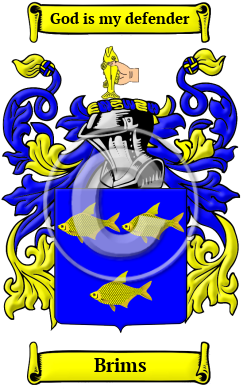
The motto was originally a war cry or slogan. Mottoes first began to be shown with arms in the 14th and 15th centuries, but were not in general use until the 17th century. Thus the oldest coats of arms generally do not include a motto. Mottoes seldom form part of the grant of arms: Under most heraldic authorities, a motto is an optional component of the coat of arms, and can be added to or changed at will; many families have chosen not to display a motto.
Motto: God is my defender
- Lower, Mark Anthony, Patronymica Britannica, A Dictionary of Family Names of the United Kingdom. London: John Russel Smith, 1860. Print.
- Reaney, P.H and R.M. Wilson, A Dictionary of English Surnames. London: Routledge, 1991. Print. (ISBN 0-415-05737-X)
- Williams, Dr Ann. And G.H. Martin, Eds., Domesday Book A Complete Translation. London: Penguin, 1992. Print. (ISBN 0-141-00523-8)
- South Australian Register Monday 9th April 1855. (Retrieved 2010, November 5) Norther Light 1855. Retrieved http://www.theshipslist.com/ships/australia/northernlight1855.shtml
- New Zealand Yesteryears Passenger Lists 1800 to 1900 (Retrieved 7th November 2010). Retrieved from http://www.yesteryears.co.nz/shipping/passlist.html
 |