
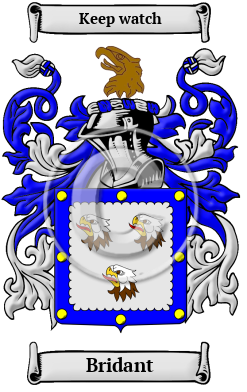
Show ContentsBridant History, Family Crest & Coats of Arms

Early Origins of the Bridant family

The surname Bridant was first found in Roxburghshire, where they held a family seat from very ancient times, some say well before the Norman Conquest and the arrival of Duke William at Hastings in 1066 A.D.

Early History of the Bridant family

This web page shows only a small excerpt of our Bridant research. Another 96 words (7 lines of text) covering the years 1296, 1400, 1527, 1590 and 1600 are included under the topic Early Bridant History in all our PDF Extended History products and printed products wherever possible.

Bridant Spelling Variations

Spelling and translation were hardly exact sciences in Medieval Scotland. Sound, rather than any set of rules, was the basis for spellings, so one name was often spelled different ways even within a single document. Spelling variations are thus an extremely common occurrence in Medieval Scottish names. Bridant has been spelled Bryden, Briden, Brydin, Bridyne, Brydyne, Brydon, Bridane, Brydone and many more.

Early Notables of the Bridant family

More information is included under the topic Early Bridant Notables in all our PDF Extended History products and printed products wherever possible.

Migration of the Bridant family

Such hard times forced many to leave their homeland in search of opportunity across the Atlantic. Many of these families settled along the east coast of North America in communities that would become the backbones of the young nations of the United States and Canada. The ancestors of many of these families have rediscovered their roots in the 20th century through the establishment of Clan societies and other patriotic Scottish organizations. Among them: William Bryden who settled in New York City in 1823; James Briden settled in New England in 1805; M. Briden settled in New Orleans in 1823.


The Bridant Motto +

The motto was originally a war cry or slogan. Mottoes first began to be shown with arms in the 14th and 15th centuries, but were not in general use until the 17th century. Thus the oldest coats of arms generally do not include a motto. Mottoes seldom form part of the grant of arms: Under most heraldic authorities, a motto is an optional component of the coat of arms, and can be added to or changed at will; many families have chosen not to display a motto.

Motto: Keep watch


Houseofnames.com on Facebook
