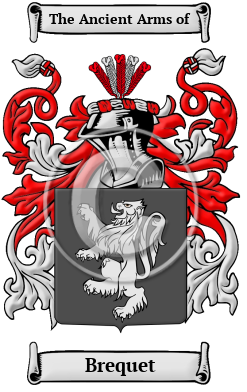
| ![Show Contents]() Brequet History, Family Crest & Coats of Arms Brequet History, Family Crest & Coats of Arms
- Origins Available:
France
Etymology of BrequetWhat does the name Brequet mean? Normandy (French: Normandie) is the region of ancient France from which the name Brequet was derived. It comes from when the family lived in Normandy. Early Origins of the Brequet familyThe surname Brequet was first found in Normandy, the former Duchy of Normandy, where this distinguished family held a family seat in ancient times. The members of the Breguet family in France were well-known watch-makers, industrialists, and inventors. Among the more prominent members was Abraham Louis Breguet (1747-1823), whose inventions in the domain of the fabrication of watches were considerable to the advancement of the watch-making industry. Abraham Louis Breguet's grandson, Louis Breguet (1804-1883), was among the notables of the 19th century, who created new precision instruments for the telegraph. His grandson, also named Louis (1880-1955), was in turn, a pioneer of modern aeronautics, being one of the first to build airplanes and helicopters in France. The Brèche and Brechard families were registered in Pas-de-Calais in 1820. The name was first found in Canada with brothers, Pierre and Jean, who were born in 1626 and 1638. 1 Early History of the Brequet familyThis web page shows only a small excerpt of our Brequet research. Another 40 words (3 lines of text) covering the years 1634 and 1664 are included under the topic Early Brequet History in all our PDF Extended History products and printed products wherever possible. Brequet Spelling VariationsFrench surnames were subject to numerous spelling alterations depending on the region and time it was used. The early development of the French language relied heavily on borrowing elements and grammar from other languages. For example, Old French was infused with Germanic words and sounds when barbarian tribes invaded and settled in France after the fall of the Roman Empire. Middle French also borrowed heavily from the Italian language during the Renaissance. As a result of these linguistic and cultural influences, the name Brequet is distinguished by a number of regional variations. The many spelling variations of the name include Brechard, Bréchard, Brèche, Breche, Brechais, Brechet, Brecher, Labrechard, Labréchard, Labrèche, Labrechais, Labrechet, Labrecher, Brequard, Bréquard, Brecque, Brèque, Brequais, Brequet, Brequer, Labreque, Labrèque, Labrecque, Labréquais, Labroque, Labrocque, Labroquère, Bregard, Brégard, Breguais, Breguet and many more. Early Notables of the Brequet familyMore information is included under the topic Early Brequet Notables in all our PDF Extended History products and printed products wherever possible. Migration of the Brequet familyFrench settlers came early to North American, following in the wake of the explorers, and creating New France. Quebec City, founded in 1608 by Samuel de Champlain is said to have been the first American site founded as a permanent settlement, rather than as just a commercial outpost. But emigration was slow, in 1643, 109 years after the first landings by Cartier, there were only about 300 French people in Quebec, and by 1663, when the region was officially made The Royal Colony of New France, by Louis XIV, there still only around 500 settlers. Over 2,000 would arrive during the next decade. Early marriage was desperately encouraged amongst the immigrants. Youths of 18 took fourteen-year-old girls for their wives. The fur trade was developed and attracted immigrants, both noble and commoner from France. By 1675, there were around 7000 French in the colony, and by that same year the Acadian presence in Nova Scotia, New Brunswick and Prince Edward Island had reached 500. In 1755, 10,000 French Acadians refused to take an oath of allegiance to England and were deported to Louisiana. Despite the loss of the Colony to England, the French people flourished in Lower Canada. Among settlers to North America of the Brequet surname were Pierre Labrecque, who emigrated to Quebec; Jeanne Chotard Labrecque, who also emigrated to Quebec; Marianne Brecher, who arrived in Texas in 1844; Balthasaar Breche, who arrived in Texas in 1846.
- Hozier, Charles D, and Antoine Bachelin-Delforenne. État présent De La Noblesse française (1883-1887): Contenant Le Distionnaire De La Noblesse Contemporaine Et Larmorial général De France, Dapres Les Manuscrits De Ch. D Hozier. Librairie Des Bibliophiles, 1884. Print.
 |