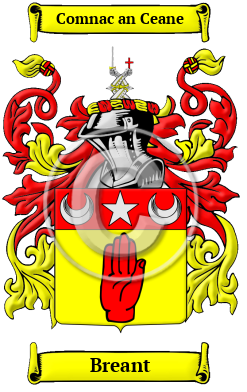
| ![Show Contents]() Breant History, Family Crest & Coats of Arms Breant History, Family Crest & Coats of Arms
Etymology of BreantWhat does the name Breant mean? The Irish name Breant has evolved from the Gaelic Mac Braoin or Ó Braoin. Early Origins of the Breant familyThe surname Breant was first found in County Kilkenny (Irish: Cill Chainnigh), the former Kingdom of Osraige (Ossory), located in Southeastern Ireland in the province of Leinster, where the family is descended through the Heremon line and claim to be direct descendants of King Niall of the Nine Hostages. They were known as the Lords of Brawney (O'Hart) and were an Ossory sept (Clann) seated near Knocktopher, Kilkenny, until they had to forfeit their lands by the Anglo Norman invasion of Strongbow, Earl of Pembroke in 1172. They were subsequently dispersed throughout Ireland. Early History of the Breant familyThis web page shows only a small excerpt of our Breant research. Another 186 words (13 lines of text) covering the years 1303, 1324, 1560 and 1625 are included under the topic Early Breant History in all our PDF Extended History products and printed products wherever possible. Breant Spelling VariationsJust like the English language, the Gaelic language of Ireland was not standardized in the Middle Ages. Therefore, one's name was often recorded under several different spellings during the life of its bearer. Spelling variations revealed in the search for the origins of the Breant family name include Breen, Breene, Brean, Breane, Bruen, Brawney, O'Breen, O'Braoin and many more. Early Notables of the Breant familyAnother 48 words (3 lines of text) are included under the topic Early Breant Notables in all our PDF Extended History products and printed products wherever possible. Breant RankingIn France, the name Breant is the 3,884th most popular surname with an estimated 1,500 - 2,000 people with that name. 1
| Breant migration to the United States | + |
Irish families left their homeland in astonishing numbers during the 19th century in search of a better life. Although individual reasons vary, most of these Irish families suffered from extreme poverty, lack of work opportunities, and exorbitant rents in their homeland. Many decided to travel to Australia or North America in the hopes of finding greater opportunities and land. The Irish immigrants that came to North America initially settled on the East Coast, often in major centers such as Boston or New York. But like the many other cultures to settle in North America, the Irish traveled to almost any region they felt held greater promise; as a result, many Irish with gold fever moved all the way out to the Pacific coast. Others before that time left for land along the St. Lawrence River and the Niagara Peninsula, or the Maritimes as United Empire Loyalists, for many Irish did choose to side with the English during the American War of Independence. The earliest wave of Irish migration, however, occurred during the Great Potato Famine of the 1840s. An examination of early immigration and passenger lists has revealed many people bearing the Breant name:
Breant Settlers in United States in the 18th Century- Anna Breant, who arrived in Virginia in 1724 2
- Rachel] Breant, who arrived in Virginia in 1724 2
- Thomas Breant, who landed in Virginia in 1724 2
Breant Settlers in United States in the 19th Century- Leon Breant, aged 19, who landed in New Orleans, La in 1850 2
- Agathe Breant, aged 25, who landed in New Orleans, La in 1850 2
The motto was originally a war cry or slogan. Mottoes first began to be shown with arms in the 14th and 15th centuries, but were not in general use until the 17th century. Thus the oldest coats of arms generally do not include a motto. Mottoes seldom form part of the grant of arms: Under most heraldic authorities, a motto is an optional component of the coat of arms, and can be added to or changed at will; many families have chosen not to display a motto.
Motto: Comnac an Ceane
Motto Translation: Fight for Right
- http://www.journaldesfemmes.com/nom-de-famille/nom/
- Filby, P. William, Meyer, Mary K., Passenger and immigration lists index : a guide to published arrival records of about 500,000 passengers who came to the United States and Canada in the seventeenth, eighteenth, and nineteenth centuries. 1982-1985 Cumulated Supplements in Four Volumes Detroit, Mich. : Gale Research Co., 1985, Print (ISBN 0-8103-1795-8)
 |