| ![Show Contents]() Boyles History, Family Crest & Coats of Arms Boyles History, Family Crest & Coats of Arms
Etymology of BoylesWhat does the name Boyles mean? The Boyles surname in Scotland is of Norman origin, thought to have derived from one of the place names such as Boyville, Boeville, and Beauville. Early Origins of the Boyles familyThe surname Boyles was first found in Ayrshire (Gaelic: Siorrachd Inbhir Àir), formerly a county in the southwestern Strathclyde region of Scotland, that today makes up the Council Areas of South, East, and North Ayrshire, where the de Boyvilles are said to have settled in Kelburn by 1140. The first record found of the name in Scotland is of a David de Boivil witnessing a charter as early as 1164. 1 Early History of the Boyles familyThis web page shows only a small excerpt of our Boyles research. Another 172 words (12 lines of text) covering the years 1200, 1280, 1291, 1296, 1488, 1566, 1588, 1607, 1620, 1621, 1627, 1629, 1639, 1643, 1667, 1679, 1691, 1694, 1699, 1703, 1745, 1747, 1772 and 1853 are included under the topic Early Boyles History in all our PDF Extended History products and printed products wherever possible. Boyles Spelling VariationsSpelling variations of this family name include: Boyle, Boyles, de Boyville and others. Early Notables of the Boyles familyRichard Boyle, 1st Earl of Cork, (1566-1643), an English settler in Ireland; The Lady Alice Boyle, Countess of Barrymore, (1607-1667) was the eldest daughter and second child of Richard Boyle, 1st Earl of Cork; Charles Boyle, 3rd Viscount Dungarvan (c.1639-1694), a British peer and politician; David Boyle, Lord Boyle (1772-1853), Scottish judge and privy counselor of...
Another 56 words (4 lines of text) are included under the topic Early Boyles Notables in all our PDF Extended History products and printed products wherever possible. Boyles RankingIn the United States, the name Boyles is the 2,065th most popular surname with an estimated 14,922 people with that name. 2 Migration of the Boyles family to IrelandSome of the Boyles family moved to Ireland, but this topic is not covered in this excerpt.
Another 161 words (12 lines of text) about their life in Ireland is included in all our PDF Extended History products and printed products wherever possible.
| Boyles migration to the United States | + |
Boyles Settlers in United States in the 18th Century- Daniel Boyles, who landed in Boston, Massachusetts in 1766 3
Boyles Settlers in United States in the 19th Century- Cornelius Boyles, who arrived in Washington County, Pennsylvania in 1803 3
- James Boyles, who landed in New York in 1839 3
- Patrick Boyles, who arrived in Tippecanoe County, Ind in 1842 3
- Thomas Boyles, aged 33, who landed in Missouri in 1844 3
- Edward Boyles, aged 40, who arrived in Mobile, Ala in 1853 3
| Boyles migration to Australia | + |
Boyles Settlers in Australia in the 19th Century- Henry Boyles, English convict from Sussex, who was transported aboard the "Arab" on July 3, 1822, settling in Van Diemen's Land, Australia 4
| Boyles migration to New Zealand | + |
Emigration to New Zealand followed in the footsteps of the European explorers, such as Captain Cook (1769-70): first came sealers, whalers, missionaries, and traders. By 1838, the British New Zealand Company had begun buying land from the Maori tribes, and selling it to settlers, and, after the Treaty of Waitangi in 1840, many British families set out on the arduous six month journey from Britain to Aotearoa to start a new life. Early immigrants include: Boyles Settlers in New Zealand in the 19th Century- Mr. George Boyles, British settler travelling from London aboard the ship "Evening Star" arriving in Dunedin, Otago, South Island, New Zealand on 14th October 1860 5
| Contemporary Notables of the name Boyles (post 1700) | + |
- Christopher David Boyles (b. 1980), American decathlete
- Denis Boyles, American writer and editor
- Harlan E. Boyles (1929-2003), American politician who served as North Carolina State Treasurer (1977-2001)
- Peter Boyles (b. 1943), American radio host in Denver, Colorado
- Kevin Boyles (b. 1967), former Canadian Olympic volleyball player
The motto was originally a war cry or slogan. Mottoes first began to be shown with arms in the 14th and 15th centuries, but were not in general use until the 17th century. Thus the oldest coats of arms generally do not include a motto. Mottoes seldom form part of the grant of arms: Under most heraldic authorities, a motto is an optional component of the coat of arms, and can be added to or changed at will; many families have chosen not to display a motto.
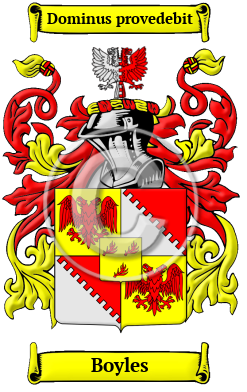
Motto: Dominus provedebit
Motto Translation: God will provide
- Black, George F., The Surnames of Scotland Their Origin, Meaning and History. New York: New York Public Library, 1946. Print. (ISBN 0-87104-172-3)
- "What are the 5,000 Most Common Last Names in the U.S.?". NameCensus.com, https://namecensus.com/last-names/
- Filby, P. William, Meyer, Mary K., Passenger and immigration lists index : a guide to published arrival records of about 500,000 passengers who came to the United States and Canada in the seventeenth, eighteenth, and nineteenth centuries. 1982-1985 Cumulated Supplements in Four Volumes Detroit, Mich. : Gale Research Co., 1985, Print (ISBN 0-8103-1795-8)
- State Library of Queensland. (Retrieved 2016, October 27) Arab voyage to Van Diemen's Land, Australia in 1822 with 155 passengers. Retrieved from http://www.convictrecords.com.au/ships/arab/1822
- New Zealand Yesteryears Passenger Lists 1800 to 1900 (Retrieved 17th October 2018). Retrieved from http://www.yesteryears.co.nz/shipping/passlist.html
 |