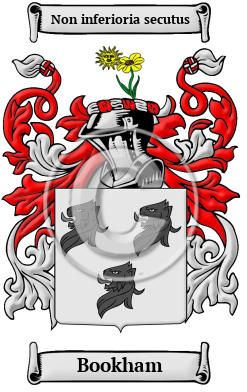
| ![Show Contents]() Bookham History, Family Crest & Coats of Arms Bookham History, Family Crest & Coats of Arms
- Origins Available:
Scotland
Etymology of BookhamWhat does the name Bookham mean? Bookham is a name whose ancestors lived among the Picts, a tribe in ancient Scotland. The Bookham family lived in the lands of Buchan in Aberdeenshire having derived from the Gaelic word for little or small. Early Origins of the Bookham familyThe surname Bookham was first found in Aberdeenshire (Gaelic: Siorrachd Obar Dheathain), a historic county, and present day Council Area of Aberdeen, located in the Grampian region of northeastern Scotland. Some of the first records of the family were Ricardus de Buchan, who was clerk of the bishopric of Aberdeen c. 1207-1208 and William de Buchan who held land in Aberdeen in 1281. A few years later, Thomas de Boghan of Edinburghshire rendered homage to King Edward I in 1296. 1 Early History of the Bookham familyThis web page shows only a small excerpt of our Bookham research. Another 231 words (16 lines of text) covering the years 1272, 1291, 1296, 1301, 1309, 1318, 1369, 1376, 1391, 1405, 1436, 1446, 1458, 1477, 1708 and 1720 are included under the topic Early Bookham History in all our PDF Extended History products and printed products wherever possible. Bookham Spelling VariationsThe appearance of the printing press and the first dictionaries in the last few hundred years did much to standardize spelling. Prior to that time scribes spelled according to sound, a practice that resulted in many spelling variations. Bookham has been spelled Buchan, Buccan, Buckan, Buchane and others. Early Notables of the Bookham familyAndrew of Buchan (d. 1309?), Bishop of Caithness, former Abbot of the Cistercian abbey of Cupar (Coupar) Angus, to which he had been preferred in 1272. His name appears on the Ragman Rolls as paying homage to Edward at the church of Perth 24 July 1291, and at Berwick-on-Tweed 28 Aug. 1296. He was nominated to the bishoric of Caithness by Pope Boniface VIII, 17 Dec. 1296. "The date of his death is usually given as 1301, but this appears to be mere conjecture, and there is...
Another 86 words (6 lines of text) are included under the topic Early Bookham Notables in all our PDF Extended History products and printed products wherever possible. Migration of the Bookham familyThe expense of the crossing to the North American colonies seemed small beside the difficulties of remaining in Scotland. It was a long and hard trip, but at its end lay the reward of freedom. Some Scots remained faithful to England and called themselves United Empire Loyalists, while others fought in the American War of Independence. Much of this lost Scottish heritage has been recovered in the last century through Clan societies and other patriotic Scottish organizations. A search of immigration and passenger lists revealed many important, early immigrants to North America bearing the name of Bookham: James Buchan who arrived in New York in 1774; George Buchan arrived in Boston Massachusetts in 1821; Thomas Buchan arrived in New York city in 1775.
The motto was originally a war cry or slogan. Mottoes first began to be shown with arms in the 14th and 15th centuries, but were not in general use until the 17th century. Thus the oldest coats of arms generally do not include a motto. Mottoes seldom form part of the grant of arms: Under most heraldic authorities, a motto is an optional component of the coat of arms, and can be added to or changed at will; many families have chosen not to display a motto.
Motto: Non inferioria secutus
Motto Translation: Not having followed mean pursuits.
- Black, George F., The Surnames of Scotland Their Origin, Meaning and History. New York: New York Public Library, 1946. Print. (ISBN 0-87104-172-3)
 |