| ![Show Contents]() Bolgere History, Family Crest & Coats of Arms Bolgere History, Family Crest & Coats of Arms
- Origins Available:
Ireland
Etymology of BolgereWhat does the name Bolgere mean? The name Bolgere has changed considerably in the time that has passed since its genesis. It originally appeared in Gaelic as Ó Bolguidir, which likely meant yellow belly (from bolg odhar). 1 Early Origins of the Bolgere familyThe surname Bolgere was first found in Wexford (Irish: Loch Garman), founded by Vikings as Waesfjord, and located in Southeastern Ireland, in the province of Leinster, where they held a family seat from very ancient times, and, even today, the name is only very rarely found outside the province of Leinster in Ireland. 2 Early History of the Bolgere familyThis web page shows only a small excerpt of our Bolgere research. Another 181 words (13 lines of text) covering the years 1570, 1608, 1672 and 1679 are included under the topic Early Bolgere History in all our PDF Extended History products and printed products wherever possible. Bolgere Spelling VariationsIn the Middle Ages many people were recorded under different spellings each time their name was written down. Research on the Bolgere family name revealed numerous spelling variations, including Bollger, Bulger, Boulger, O'Bolger, O'Bulger, Bolger, Bolgire, Bulgire, O'Bulgire, O'Bolgire and many more. Early Notables of the Bolgere familyMore information is included under the topic Early Bolgere Notables in all our PDF Extended History products and printed products wherever possible. Migration of the Bolgere familyThe 18th century saw the slow yet steady emigration of Irish families to British North America and the United States. Those early Irish settlers that left their homeland were typically moderately well off: they were enticed by the promise of a sizable plot of land. However, by the 1840s, this pattern of immigration was gone: immigrants to North America were seeking refuge from the starvation and disease that the Great Potato Famine of that decade brought. The great numbers of Irish that arrived to the United States and the soon to be Canada were instrumental in their quick development as powerful industrial nations. An examination of early immigration and passenger lists uncovered many early immigrants bearing the name Bolgere: John Bolger who settled in Boston Massachusetts with his wife Cathy in 1804; typical of the five families who left Ireland during the Potato Famine between 1846/1854 was Thomas Bolger, his wife and five children who sailed on the ".
The motto was originally a war cry or slogan. Mottoes first began to be shown with arms in the 14th and 15th centuries, but were not in general use until the 17th century. Thus the oldest coats of arms generally do not include a motto. Mottoes seldom form part of the grant of arms: Under most heraldic authorities, a motto is an optional component of the coat of arms, and can be added to or changed at will; many families have chosen not to display a motto.
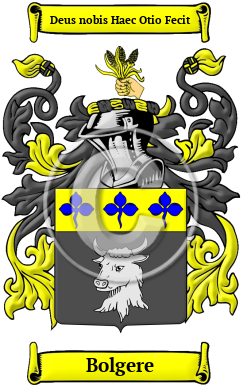
Motto: Deus nobis Haec Otio Fecit
Motto Translation: God made ??us this leisure
- MacLysaght, Edward, The Surnames of Ireland. Ireland: Irish Academic Press, sixth edition, 1985. Print. (ISBN 0-7165-2366-3)
- MacLysaght, Edward, More Irish Families. Dublin: Irish Academic Press, 1982. Print. (ISBN 0-7165-0126-0)
 |