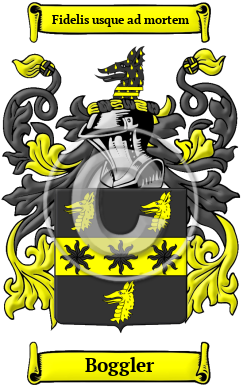
The name Boggler finds its origins with the ancient Anglo-Saxons of England. It was given to one who worked as a manufacturer of buckles having derived from the Old French word bouclier, which literally means buckle-maker
Loading...
Early Origins of the Boggler family
The surname Boggler was first found in Berkshire, where they held a family seat from very ancient times, some say well before the Norman Conquest and the arrival of Duke William at Hastings in 1066 A.D.
Early History of the Boggler family
This web page shows only a small excerpt of our Boggler research. Another 99 words (7 lines of text) covering the years 1544, 1550 and 1886 are included under the topic Early Boggler History in all our PDF Extended History products and printed products wherever possible.
Boggler Spelling Variations
The English language only became standardized in the last few centuries; therefore, spelling variations are common among early Anglo-Saxon names. As the form of the English language changed, even the spelling of literate people's names evolved. Boggler has been recorded under many different variations, including Buckler, Bucklar, Bukler and others.
Early Notables of the Boggler family
More information is included under the topic Early Boggler Notables in all our PDF Extended History products and printed products wherever possible.
Loading...
Loading...
Loading...
Loading...
Migration of the Boggler family
For many English families, the political and religious disarray that shrouded England made the far away New World an attractive prospect. On cramped disease-ridden ships, thousands migrated to those British colonies that would eventually become Canada and the United States. Those hardy settlers that survived the journey often went on to make important contributions to the emerging nations in which they landed. Analysis of immigration records indicates that some of the first North American immigrants bore the name Boggler or a variant listed above: Andrew Buckler who arrived in Virginia in 1606, fourteen years before the "Mayflower"; Charles Buckler, who settled in New England in 1685; William Buckler, who came to New England in 1654.
The motto was originally a war cry or slogan. Mottoes first began to be shown with arms in the 14th and 15th centuries, but were not in general use until the 17th century. Thus the oldest coats of arms generally do not include a motto. Mottoes seldom form part of the grant of arms: Under most heraldic authorities, a motto is an optional component of the coat of arms, and can be added to or changed at will; many families have chosen not to display a motto.
Motto: Fidelis usque ad mortem Motto Translation: Faithful even unto death.
Remove Item
WARNING!
Removing this item from your shopping cart will remove your associated sale items.
Are you sure you want to delete this item from your shopping cart?