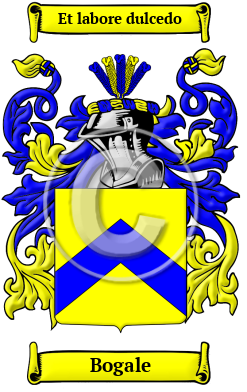
The chronicles of the Bogale family suggest that their ancestors may have been Viking settlers. Their surname comes from a place name of Norse origins, from when they lived at Bowgyhill, in Monkland, in Lanarkshire. One reference lists the name as a nickname, but this is highly unlikely.
Loading...
Early Origins of the Bogale family
The surname Bogale was first found in Lanarkshire (Gaelic: Siorrachd Lannraig) a former county in the central Strathclyde region of Scotland, now divided into the Council Areas of North Lanarkshire, South Lanarkshire, and the City of Glasgow, where they held a family seat from ancient times.
Early History of the Bogale family
This web page shows only a small excerpt of our Bogale research. Another 199 words (14 lines of text) covering the years 1200, 1487, 1510 and 1520 are included under the topic Early Bogale History in all our PDF Extended History products and printed products wherever possible.
Bogale Spelling Variations
The spellings of Scottish names dating from the medieval era often bear little resemblance to those seen today. They vary enormously because scribes in that time spelled according to their ears. Some spelling variations of the name Bogale include Bogle, Bogill, Bogyll, Bogell, Bogil, Boagle, Boagill, Boagell, Boghill, Bogall, Bogale, Bogille, Bogylle, Bogel, Bogehill and many more.
Early Notables of the Bogale family
More information is included under the topic Early Bogale Notables in all our PDF Extended History products and printed products wherever possible.
Loading...
Loading...
Loading...
Loading...
Migration of the Bogale family
The farms of Scottish settlers soon dotted the east coast of the colonies that would become the nations of the United States and Canada. Many of those migrants and their children went on to play important roles in the founding the great nations of North America. Early North American immigration records have revealed a number of people bearing the Scottish name Bogale or a variant listed above, including: Robert Bogle who settled in Grenada in 1774; Robert Bogle settled in New Orleans in 1820; James, Leonard and Robert Bogle settled in Philadelphia between 1832 to 1860..
The motto was originally a war cry or slogan. Mottoes first began to be shown with arms in the 14th and 15th centuries, but were not in general use until the 17th century. Thus the oldest coats of arms generally do not include a motto. Mottoes seldom form part of the grant of arms: Under most heraldic authorities, a motto is an optional component of the coat of arms, and can be added to or changed at will; many families have chosen not to display a motto.
Motto: Et labore dulcedo Motto Translation: Both sweetness and work
Remove Item
WARNING!
Removing this item from your shopping cart will remove your associated sale items.
Are you sure you want to delete this item from your shopping cart?