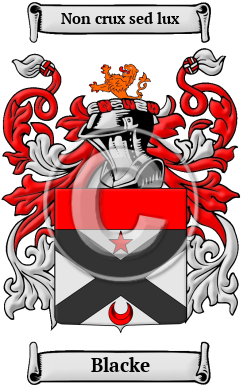
| ![Show Contents]() Blacke History, Family Crest & Coats of Arms Blacke History, Family Crest & Coats of Arms
Etymology of BlackeWhat does the name Blacke mean? The annals of the ancient Scottish bards frequently refer to the surname Blacke and it springs from three separate and distinct sources. In examining the ancient origins, historians are undecided whether the name Black derives from the Old English Blaecor Blac. The former means black the color, but the later means the opposite, that is, pale or bright. However, it is concluded that it is Anglo-Saxon in origin, and one of the first references to the family Black is when Blaecca was a prefect of the city of Lincoln, England in 628 and he and his family were recorded as being converted to Christianity by Paulinus, a missionary. Early Origins of the Blacke familyThe surname Blacke was first found in Lincolnshire. The movement northwards appears to have taken place about 1175 A.D. when Hugh Niger is recorded in Angus (Niger is the Latin version of Black). Adam de Black was a juror in an inquisition held at Lanark in 1303 and from this point in time, the more complete records of the period yield no less than twenty one references to members of the Black family in the Scottish lowlands and as far north as Inverness and Aberdeen. Early History of the Blacke familyThis web page shows only a small excerpt of our Blacke research. Another 122 words (9 lines of text) covering the years 1501, 1562, 1563, 1756, 1760 and 1890 are included under the topic Early Blacke History in all our PDF Extended History products and printed products wherever possible. Blacke Spelling VariationsSpelling variations of this family name include: Black, Blacke and others. Early Notables of the Blacke familyJohn Blak or Black (d. 1563), a Dominican friar of Aberdeen. "His public disputation with John Willox took place in Edinburgh in the summer of 1501. Bishop Lesley gives the three heads of their disputation, and adds that in the end nothing was agreed. Indeed it would seem that the only important result of such discussions was to exasperate the temper of the...
Another 63 words (4 lines of text) are included under the topic Early Blacke Notables in all our PDF Extended History products and printed products wherever possible. Migration of the Blacke family to IrelandSome of the Blacke family moved to Ireland, but this topic is not covered in this excerpt.
Another 61 words (4 lines of text) about their life in Ireland is included in all our PDF Extended History products and printed products wherever possible.
| Blacke migration to the United States | + |
Blacke Settlers in United States in the 17th Century- Francis Blacke, who arrived in Virginia in 1639 1
- John Blacke, who landed in Virginia in 1649 1
- Elizabeth Blacke, who landed in Virginia in 1649 1
- Daniel Blacke, who arrived in New England in 1651 1
- Robert Blacke, who landed in Virginia in 1651 1
- ... (More are available in all our PDF Extended History products and printed products wherever possible.)
Blacke Settlers in United States in the 18th Century- Rebecca Blacke, who landed in Virginia in 1701 1
The motto was originally a war cry or slogan. Mottoes first began to be shown with arms in the 14th and 15th centuries, but were not in general use until the 17th century. Thus the oldest coats of arms generally do not include a motto. Mottoes seldom form part of the grant of arms: Under most heraldic authorities, a motto is an optional component of the coat of arms, and can be added to or changed at will; many families have chosen not to display a motto.
Motto: Non crux sed lux
Motto Translation: Not the cross, but the light.
- Filby, P. William, Meyer, Mary K., Passenger and immigration lists index : a guide to published arrival records of about 500,000 passengers who came to the United States and Canada in the seventeenth, eighteenth, and nineteenth centuries. 1982-1985 Cumulated Supplements in Four Volumes Detroit, Mich. : Gale Research Co., 1985, Print (ISBN 0-8103-1795-8)
 |