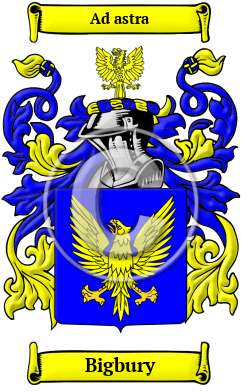
| ![Show Contents]() Bigbury History, Family Crest & Coats of Arms Bigbury History, Family Crest & Coats of Arms
- Origins Available:
England
Early Origins of the Bigbury familyThe surname Bigbury was first found in Suffolk and Nottingham where they held a family seat from ancient times, long before the Norman Conquest in 1066. One source notes that the family could have been from Bigby, a parish, in the union of Caistor, S. division of the wapentake of Yarborough, parts of Lindsey, in Lincolnshire. 1 To the south in Devon, we found this interesting entry for the family: Bigbury [in the parish of Modbury] was held by lords of that name as early as the reign of John ; and after nine descents was brought by a coheiress to one of the Champernownes of Beer Ferrers, from whom it descended through the Willoughbys to the Paulets. There is a fifteenth-century Bigbury brass in the church." 2 Early History of the Bigbury familyThis web page shows only a small excerpt of our Bigbury research. Another 53 words (4 lines of text) covering the years 1695, 1792 and 1881 are included under the topic Early Bigbury History in all our PDF Extended History products and printed products wherever possible. Bigbury Spelling VariationsBefore the last few hundred years, the English language had no fast system of spelling rules. For that reason, spelling variations are commonly found in early Anglo-Saxon surnames. Over the years, many variations of the name Bigbury were recorded, including Bigsby, Bixby, Bigby, Bigbury, Bigsbury and many more. Early Notables of the Bigbury familyJohn Jeremiah Bigsby (1792-1881), English geologist and physician, eponym of the Bigsby Medal; and Sir Thomas Bigsby.
Angel Bix (d. 1695), was a Franciscan friar, who "after filling the office of confessor to the Poor Clares at Aire...
Another 36 words (3 lines of text) are included under the topic Early Bigbury Notables in all our PDF Extended History products and printed products wherever possible. Migration of the Bigbury familyTo escape oppression and starvation at that time, many English families left for the "open frontiers" of the New World with all its perceived opportunities. In droves people migrated to the many British colonies, those in North America in particular, paying high rates for passages in cramped, unsafe ships. Although many of the settlers did not make the long passage alive, those who did see the shores of North America perceived great opportunities before them. Many of the families that came from England went on to make essential contributions to the emerging nations of Canada and the United States. Research into various historical records revealed some of first members of the Bigbury family emigrate to North America: Joseph Bixby who settled in Massachusetts in 1620; Robert Bigsby settled in Virginia in 1731; Thomas Bigby settled in Tobago in the West Indies in 1775.
The motto was originally a war cry or slogan. Mottoes first began to be shown with arms in the 14th and 15th centuries, but were not in general use until the 17th century. Thus the oldest coats of arms generally do not include a motto. Mottoes seldom form part of the grant of arms: Under most heraldic authorities, a motto is an optional component of the coat of arms, and can be added to or changed at will; many families have chosen not to display a motto.
Motto: Ad astra
Motto Translation: To the stars.
- Barber, Henry, British Family Names London: Elliot Stock, 62 Paternoster Row, 1894. Print.
- Worth, R.N., A History of Devonshire London: Elliot Stock, 62, Paternoster Row, E.G., 1895. Digital
 |