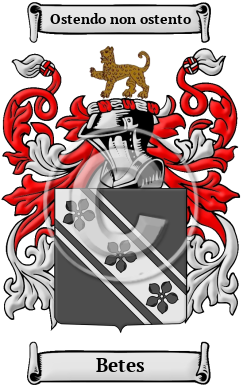
| ![Show Contents]() Betes History, Family Crest & Coats of Arms Betes History, Family Crest & Coats of Arms
- Origins Available:
England
Etymology of BetesWhat does the name Betes mean? The Betes name is an important part of the history of the ancient Anglo-Saxon tribes of Britain. Betes is derived from one of a number of personal names. The surname Betes is usually explained as a metronymic derivative of the female personal name Beatrice, or less often, Elizabeth. 1 However, the name is undoubtedly occasionally derived from the male personal name Bartholomew, which also took the variant forms Bertram or Bertelmew. The surname Betes may also be a "local" type surname which means a dweller by the hollows. Early Origins of the Betes familyThe surname Betes was first found in Norfolk, where they held a family seat from ancient times, long before the Norman Conquest in 1066. "One of the principal stocks of the old and characteristic Norfolk name of Betts included the family that possessed, in the 15th and 16th centuries, the manors of Hastings Hall and Whitefoot in Irmingland. This name is also well represented in Lincolnshire, where it usually takes the form of Bett; it is also present, though less numerous, in the other east coast counties of Suffolk and Kent." 2 Early History of the Betes familyThis web page shows only a small excerpt of our Betes research. Another 178 words (13 lines of text) covering the years 1200, 1379, 1480, 1500, 1570, 1576, 1581, 1590, 1642, 1643, 1646, 1647, 1695, 1743, 1770, 1905 and 1912 are included under the topic Early Betes History in all our PDF Extended History products and printed products wherever possible. Betes Spelling VariationsBefore the last few hundred years, the English language had no fast system of spelling rules. For that reason, spelling variations are commonly found in early Anglo-Saxon surnames. Over the years, many variations of the name Betes were recorded, including Betts, Bets, Bettes, Bett, Bette and others. Early Notables of the Betes familyJohn Bettes (d. 1570?), an English miniature painter, commonly stated to have been a pupil of Nicholas Hilliard. "Bettes painted a miniature in oils of Queen Elizabeth, which is said to have been highly successful. He is mentioned by Foxe in his 'Ecclesiastical History' as having engraved a pedigree and some vignettes for Hall's 'Chronicle.' He is also said to have painted the portrait of Sir John Godsalve. Foxe speaks of Bettes as already dead in 1576...
Another 77 words (6 lines of text) are included under the topic Early Betes Notables in all our PDF Extended History products and printed products wherever possible. Migration of the Betes familyTo escape oppression and starvation at that time, many English families left for the "open frontiers" of the New World with all its perceived opportunities. In droves people migrated to the many British colonies, those in North America in particular, paying high rates for passages in cramped, unsafe ships. Although many of the settlers did not make the long passage alive, those who did see the shores of North America perceived great opportunities before them. Many of the families that came from England went on to make essential contributions to the emerging nations of Canada and the United States. Research into various historical records revealed some of first members of the Betes family emigrate to North America: Richard Betts of Suffolk who settled on Long Island in 1665; and some of the distinguished American families were Henry Betts of Danbury, Conn.; Thomas Betts of Guildford, Conn..
The motto was originally a war cry or slogan. Mottoes first began to be shown with arms in the 14th and 15th centuries, but were not in general use until the 17th century. Thus the oldest coats of arms generally do not include a motto. Mottoes seldom form part of the grant of arms: Under most heraldic authorities, a motto is an optional component of the coat of arms, and can be added to or changed at will; many families have chosen not to display a motto.
Motto: Ostendo non ostento
Motto Translation: I show, not boast.
- Arthur, William , An Etymological Dictionary of Family and Christian Names. London: 1857. Print
- Guppy, Henry Brougham, Homes of Family Names in Great Britain. 1890. Print.
 |