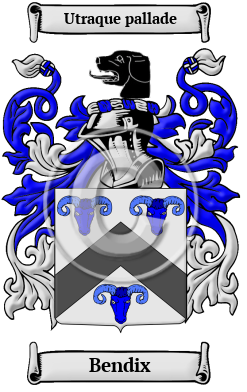
| ![Show Contents]() Bendix History, Family Crest & Coats of Arms Bendix History, Family Crest & Coats of Arms
- Origins Available:
England
Etymology of BendixWhat does the name Bendix mean? Bendix is a name of ancient Anglo-Saxon origin and comes from a family once having lived at either Bendish in Hertfordshire, or Bendish Hall, which was located in Radwinter in the county of Essex. Early Origins of the Bendix familyThe surname Bendix was first found in Essex where they held a family seat from very ancient times, some say well before the Norman Conquest and the arrival of Duke William at Hastings in 1066 A.D. Early History of the Bendix familyThis web page shows only a small excerpt of our Bendix research. Another 69 words (5 lines of text) covering the years 1607, 1650, 1670, 1674 and 1726 are included under the topic Early Bendix History in all our PDF Extended History products and printed products wherever possible. Bendix Spelling VariationsThe English language only became standardized in the last few centuries; therefore,spelling variations are common among early Anglo-Saxon names. As the form of the English language changed, even the spelling of literate people's names evolved. Bendix has been recorded under many different variations, including Bendish, Bendidge, Benditch, Bendige and others. Early Notables of the Bendix familySir Thomas Bendish, 1st Baronet of Steeple Bumpstead in the county of Essex; and Sir Thomas Bendish, 2nd Baronet (c.1607-1674), of Topesfield Hall who served as the English ambassador to the Ottoman sultanate.
Bridget Bendish (1650-1726), was Oliver Cromwell's granddaughter, daughter of General Henry Ireton, by his wife Bridget, Cromwell's eldest daughter. As a child she...
Another 54 words (4 lines of text) are included under the topic Early Bendix Notables in all our PDF Extended History products and printed products wherever possible.
| Bendix migration to the United States | + |
For many English families, the political and religious disarray that shrouded England made the far away New World an attractive prospect. On cramped disease-ridden ships, thousands migrated to those British colonies that would eventually become Canada and the United States. Those hardy settlers that survived the journey often went on to make important contributions to the emerging nations in which they landed. Analysis of immigration records indicates that some of the first North American immigrants bore the name Bendix or a variant listed above:
Bendix Settlers in United States in the 19th Century- Andrew Bendix, who landed in Philadelphia, Pennsylvania in 1806 1
- Heinrich Bendix, who arrived in America in 1845 1
- Jakob Bendix, who landed in America in 1854 1
| Bendix migration to Australia | + |
Bendix Settlers in Australia in the 19th Century- Carl Bendix, aged 39, who arrived in South Australia in 1857 aboard the ship "Victoria"
| Contemporary Notables of the name Bendix (post 1700) | + |
- William Bendix (1906-1964), American film, radio, and television actor
- Vincent Hugo Bendix (1881-1945), American inventor and industrialist, founder of the Bendix Corporation of Chicago
- Reinhard Bendix (1916-1991), German American sociologist
- Victor Emanuel Bendix (1851-1926), Danish composer, conductor, and pianist
- Bendix Harms (b. 1967), German contemporary artist
The motto was originally a war cry or slogan. Mottoes first began to be shown with arms in the 14th and 15th centuries, but were not in general use until the 17th century. Thus the oldest coats of arms generally do not include a motto. Mottoes seldom form part of the grant of arms: Under most heraldic authorities, a motto is an optional component of the coat of arms, and can be added to or changed at will; many families have chosen not to display a motto.
Motto: Utraque pallade
Motto Translation: With either Pallas.
- Filby, P. William, Meyer, Mary K., Passenger and immigration lists index : a guide to published arrival records of about 500,000 passengers who came to the United States and Canada in the seventeenth, eighteenth, and nineteenth centuries. 1982-1985 Cumulated Supplements in Four Volumes Detroit, Mich. : Gale Research Co., 1985, Print (ISBN 0-8103-1795-8)
 |