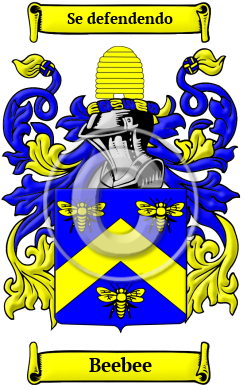
| ![Show Contents]() Beebee History, Family Crest & Coats of Arms Beebee History, Family Crest & Coats of Arms
- Origins Available:
England
Etymology of BeebeeWhat does the name Beebee mean? The name Beebee was derived from a place name in Leicestershire called Beeby. The place name is derived from the Old English "beo," meaning "bee," and "byr," or "settlement." That is, it was "the place where they kept bees." 1 The Domesday Book of 1086, records the parish as "Bebi." 2 Early Origins of the Beebee familyThe surname Beebee was first found in Leicestershire, England at Beeby, 3 a parish, in the union of Barrow-upon-Soar, hundred of East Goscote 4 where John de Beby was listed in the Subsidy Rolls of 1327. In Yorkshire, the first record there was that of Richard Bebie who was a Freeman of York in 1596. Robert Beeby was later listed in Suffolk in 1674. 5 "The Beebys originally took their name from a Leicestershire parish. In the reign of Henry III., Hugh de Beby was rector of Willoughby Waterless, and William de Beby was rector of Claybrook (N.). Between the reigns of Edward III. and Henry V., four mayors of Leicester bore the name of Bebye, or Beebye, or De Beby (T.). William Beeby was a Gaddesby freeholder in the time of Charles I.; Richard Beeby and Elizabeth Hubbert were married in Belgrave church in the reign of Charles II.; in the middle of last century Francis Beeby was a proprietor of land in Fleckney and a family of the name then lived at Shenton (N.). The name is still in the city of Leicester." 6 Early History of the Beebee familyThis web page shows only a small excerpt of our Beebee research. Another 179 words (13 lines of text) covering the years 1744, 1760, 1775, 1840, 1889, 1922, 1963 and 1986 are included under the topic Early Beebee History in all our PDF Extended History products and printed products wherever possible. Beebee Spelling VariationsUntil quite recently, the English language has lacked a definite system of spelling rules. Consequently, Anglo-Saxon surnames are characterized by a multitude of spelling variations. Changes in Anglo-Saxon names were influenced by the evolution of the English language, as it incorporated elements of French, Latin, and other languages. Although Medieval scribes and church officials recorded names as they sounded, so it is common to find one person referred to by several different spellings of his surname, even the most literate people varied the spelling of their own names. Variations of the name Beebee include Beeby, Beebee, Beebe, Bebe, Beebey and others. Early Notables of the Beebee familyAnother 32 words (2 lines of text) are included under the topic Early Beebee Notables in all our PDF Extended History products and printed products wherever possible. Migration of the Beebee familySearching for a better life, many English families migrated to British colonies. Unfortunately, the majority of them traveled under extremely harsh conditions: overcrowding on the ships caused the majority of the immigrants to arrive diseased, famished, and destitute from the long journey across the ocean. For those families that arrived safely, modest prosperity was attainable, and many went on to make invaluable contributions to the development of the cultures of the new colonies. Research into the origins of individual families in North America revealed records of the immigration of a number of people bearing the name Beebee or a variant listed above: John Beebe, who came to America in 1650; Lydia Beebe, who came to New London, CT in 1650; Samuel Beebe, who settled in America in 1650; Thomas Beebe, who came to America in 1650.
| Contemporary Notables of the name Beebee (post 1700) | + |
- Jacob Beebee, American politician, Member of New York State Assembly from Washington County, 1812-13
- Trevor Beebee, Professor of Molecular Ecology at the University of Sussex
- Henry Beebee Carrington (1824-1912), United States Army officer and historian
The motto was originally a war cry or slogan. Mottoes first began to be shown with arms in the 14th and 15th centuries, but were not in general use until the 17th century. Thus the oldest coats of arms generally do not include a motto. Mottoes seldom form part of the grant of arms: Under most heraldic authorities, a motto is an optional component of the coat of arms, and can be added to or changed at will; many families have chosen not to display a motto.
Motto: Se defendendo
Motto Translation: In his own defence.
- Bardsley, C.W, A Dictionary of English and Welsh Surnames: With Special American Instances. Wiltshire: Heraldry Today, 1901. Print. (ISBN 0-900455-44-6)
- Williams, Dr Ann. And G.H. Martin, Eds., Domesday Book A Complete Translation. London: Penguin, 1992. Print. (ISBN 0-141-00523-8)
- Lower, Mark Anthony, Patronymica Britannica, A Dictionary of Family Names of the United Kingdom. London: John Russel Smith, 1860. Print.
- Lewis, Samuel, A Topographical Dictionary of England. Institute of Historical Research, 1848, Print.
- Reaney, P.H and R.M. Wilson, A Dictionary of English Surnames. London: Routledge, 1991. Print. (ISBN 0-415-05737-X)
- Guppy, Henry Brougham, Homes of Family Names in Great Britain. 1890. Print.
 |