| ![Show Contents]() Bassets History, Family Crest & Coats of Arms Bassets History, Family Crest & Coats of Arms
Etymology of BassetsWhat does the name Bassets mean? Following the Norman Conquest of England in 1066, the name Bassets was first found in Britina. It was a name for a person of small stature having derived from the Old English word bas, meaning of low stature. 1 Early Origins of the Bassets familyThe surname Bassets was first found in Staffordshire where the family traces back to Thurston, a Norman who held six hides of land in Drayton (known today as Dayton Bassett.) Thurston was the "paternal ancestor of several families of Basset, which rose to power and distinction very shortly after the Conquest. Ralph Basset [(died 1265)], the illustrious founder of their greatness, is said to have been raised by Henry I, from a lowly condition, and to have been 'exalted above earls and other eminent men.' True it is he was constituted Justice of England, and invested with the power of sitting in whatever court he pleased." 2 "Thurstan Basset appears in the Roll of Battle Abbey." 3 One source claims that the family may have branched to Withcote in Leicestershire in ancient times. "At the south-western extremity of the parish [of Withcote] may be traced the foundations and embankments of Solay or Sawley Castle, a place of great importance in the baronial wars, supposed to have been built by the Bassett family." 4 The aforementioned Ralph Basset was father of Ralph Basset, 1st Lord Basset of Drayton and Maud (c. 1265-1299.) He rose to become Governor of Edinburgh Castle (1291-1296.) His son Ralph Basset III was killed at the Battle of Evesham one year after his appointment. Wooton-Bassett, a market-town and parish, and formerly a representative borough, in the union of Cricklade and Wootton-Bassett, hundred of Kingsbridge in Wiltshire was an ancient family seat. "This place, which appears to have been originally of greater importance than it is at present, was, at the time of the Norman Conquest, called Wodeton, from wode, a wood, and tun, a town. About a century after that period, it became the property of the noble family of Bassett, from whom it derived the adjunct to its name." 4 "At the upper end of the north aisle [of the church at Blore, Staffordshire], within a kind of chantry chapel, is a noble altar-tomb of statuary marble, supposed to be to the memory of William, the last male heir of the Bassetts, who was living in 1588; there is also a brass, dated 1400, in the aisle." 4 Early History of the Bassets familyThis web page shows only a small excerpt of our Bassets research. Another 79 words (6 lines of text) covering the years 1050, 1093, 1198, 1330, 1597, 1602, 1625, 1626, 1628, 1640, 1641, 1644, 1656, 1669, 1673, 1674, 1679, 1681, 1687, 1688, 1693, 1695, 1720, 1721 and 1890 are included under the topic Early Bassets History in all our PDF Extended History products and printed products wherever possible. Bassets Spelling VariationsIt is only in the last few hundred years that the English language has been standardized. For that reason, Anglo-Norman surnames like Bassets are characterized by many spelling variations. Scribes and monks in the Middle Ages spelled names they sounded, so it is common to find several variations that refer to a single person. As the English language changed and incorporated elements of other European languages such as Norman French and Latin, even literate people regularly changed the spelling of their names. The variations of the name Bassets include Bassett, Basset, Bassit, Basett and others. Early Notables of the Bassets familyLord Basset of Drayton; Lord Basset of Weldon; Sir Robert Basset of Umberley, a colonel in the English Army; Arthur Basset (1597-1673), an English politician who sat in the House of Commons from 1625 to 1626; William Bassett (c. 1602-1656), an English landowner and politician, Member of Parliament for Bath (1640-1644), supported the Royalist cause in the...
Another 57 words (4 lines of text) are included under the topic Early Bassets Notables in all our PDF Extended History products and printed products wherever possible. Migration of the Bassets family to IrelandSome of the Bassets family moved to Ireland, but this topic is not covered in this excerpt.
Another 50 words (4 lines of text) about their life in Ireland is included in all our PDF Extended History products and printed products wherever possible. Migration of the Bassets familyFaced with the chaos present in England at that time, many English families looked towards the open frontiers of the New World with its opportunities to escape oppression and starvation. People migrated to North America, as well as Australia and Ireland in droves, paying exorbitant rates for passages in cramped, unsafe ships. Many of the settlers did not make the long passage alive, but those who did see the shores of North America were welcomed with great opportunity. Many of the families that came from England went on to make essential contributions to the emerging nations of Canada and the United States. Some of the first immigrants to cross the Atlantic and come to North America carried the name Bassets, or a variant listed above: Oliver Bassett who settled in Barbados in 1635; George Basset in Virginia 1637; William Basset in Virginia in 1622; Arnold Basset settled in New York state in 1693.
The motto was originally a war cry or slogan. Mottoes first began to be shown with arms in the 14th and 15th centuries, but were not in general use until the 17th century. Thus the oldest coats of arms generally do not include a motto. Mottoes seldom form part of the grant of arms: Under most heraldic authorities, a motto is an optional component of the coat of arms, and can be added to or changed at will; many families have chosen not to display a motto.
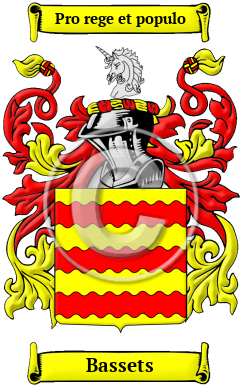
Motto: Pro rege et populo
Motto Translation: For King and people.
- Reaney, P.H and R.M. Wilson, A Dictionary of English Surnames. London: Routledge, 1991. Print. (ISBN 0-415-05737-X)
- Burke, John Bernard, The Roll of Battle Abbey. London: Edward Churton, 26, Holles Street, 1848, Print.
- Smith, George (ed), Dictionary of National Biography. London: Smith, Elder & Co., 1885-1900. Print
- Lewis, Samuel, A Topographical Dictionary of England. Institute of Historical Research, 1848, Print.
 |