


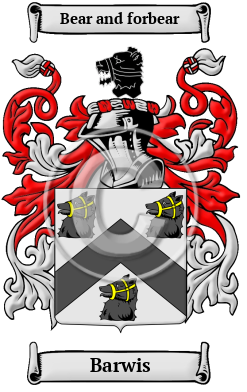
Show ContentsBarwis History, Family Crest & Coats of Arms

Early Origins of the Barwis family

The surname Barwis was first found in Cumberland, where they held a family seat on the English/Scottish border. After the Norman Conquest of England many of Duke William's rebellious Barons moved north. The border became a convenient but turbulent no-man's land where the persecuted Many were given land by King Malcolm Canmore and later by King David of Scotland. Some were native Scots. In the 16th century they became known as the 'unruly clans'.

Early History of the Barwis family

This web page shows only a small excerpt of our Barwis research. Another 137 words (10 lines of text) covering the years 1234, 1374, 1510, 1580, 1600, 1601, 1616, 1621, 1628, 1635, 1648, 1649, 1652 and 1662 are included under the topic Early Barwis History in all our PDF Extended History products and printed products wherever possible.

Barwis Spelling Variations

Spelling variations of this family name include: Barwise, Barwis, Barwese, Barwize, Barwiss and many more.

Early Notables of the Barwis family

  • Anthony Barwis (1580-1616), and his son, Richard Barwis (1601-1648), an English politician, Member of Parliament for Carlisle in 1628, High Sheriff of Cumberland in 1635, known as "Great Richard" Barw...
  • his uncle, Richard Barwis of Waverton (d. 1662), High Sheriff of Cumberland in 1648, 1649 and 1652
  • Colonel Thomas Barwis (1621-1648) fought on the Parliamentary side at the siege of Carlisle

Barwis migration to Australia+

Barwis Settlers in Australia in the 19th Century
  • Hodgson Thomas Barwis, aged 47, a policeman, who arrived in South Australia in 1851 aboard the ship "Reliance" 1

Contemporary Notables of the name Barwis (post 1700)+

  • Mike Barwis, American head coach at the University of Michigan (2007-)


The Barwis Motto+

The motto was originally a war cry or slogan. Mottoes first began to be shown with arms in the 14th and 15th centuries, but were not in general use until the 17th century. Thus the oldest coats of arms generally do not include a motto. Mottoes seldom form part of the grant of arms: Under most heraldic authorities, a motto is an optional component of the coat of arms, and can be added to or changed at will; many families have chosen not to display a motto.

Motto: Bear and forbear


  1. State Records of South Australia. (Retrieved 2010, November 5) RELIANCE 1851. Retrieved http://www.slsa.sa.gov.au/BSA/1851Reliance.htm


Houseofnames.com on Facebook