| ![Show Contents]() Baldinge History, Family Crest & Coats of Arms Baldinge History, Family Crest & Coats of Arms
- Origins Available:
England
Etymology of BaldingeWhat does the name Baldinge mean? The earliest origins of the name Baldinge date back to the time of the Anglo-Saxons. The name is derived from the Old English personal name Bealding, which was originally derived from the name Beald. The name was not recorded before the Conquest. 1 Early Origins of the Baldinge familyThe surname Baldinge was first found in Lincolnshire, where Joscius filius Balding was listed in the Curia Regis Rolls during the reign of Richard I. Gilbertus filius Balding was also found in Lincolnshire as recorded in the Curia Regis Rolls form 1212. Alice and John Baldyng were found in the Subsidy Rolls from Sussex in 1327, as was Robert Beldyng in 1332. 1 As far as understanding spelling variations is concerned, we found this interesting entry: "In 1674, Suffolk Anthony Baldin and Bartholomew Baldinge occur side by side with Baldwin, so that Balding is sometimes a late development of Baldwin." 1 The Hundredorum Rolls of 1273 included: William Bolding, Salop (Shropshire.) 2 And in Norfolk, John Bolden was listed there 2 Edward VI (during the second year of the reign of Edward IV). 3 Early History of the Baldinge familyThis web page shows only a small excerpt of our Baldinge research. Another 99 words (7 lines of text) covering the years 1212, 1251, 1255, 1327, 1332, 1513, 1518, 1519, 1529 and 1674 are included under the topic Early Baldinge History in all our PDF Extended History products and printed products wherever possible. Baldinge Spelling VariationsUntil quite recently, the English language has lacked a definite system of spelling rules. Consequently, Anglo-Saxon surnames are characterized by a multitude of spelling variations. Changes in Anglo-Saxon names were influenced by the evolution of the English language, as it incorporated elements of French, Latin, and other languages. Although Medieval scribes and church officials recorded names as they sounded, so it is common to find one person referred to by several different spellings of his surname, even the most literate people varied the spelling of their own names. Variations of the name Baldinge include Balding, Baulding, Baldyne, Bolding, Baldyng, Beldyng, Baldinge, Baldin, Poldin and many more. Early Notables of the Baldinge familyGilebertus filius Baalding, a prominent 13th century landholder in Lincolnshire.
Noel Baulduin or Baudouin, was a native of the Netherlands, contemporary with Josquin des Prés, and from 1513 to 1518 chapel-master of the church of Notre Dame at Antwerp, where he died in 1529. Two of his motets were printed by Petrucci of Fossombrone in...
Another 53 words (4 lines of text) are included under the topic Early Baldinge Notables in all our PDF Extended History products and printed products wherever possible. Migration of the Baldinge familySearching for a better life, many English families migrated to British colonies. Unfortunately, the majority of them traveled under extremely harsh conditions: overcrowding on the ships caused the majority of the immigrants to arrive diseased, famished, and destitute from the long journey across the ocean. For those families that arrived safely, modest prosperity was attainable, and many went on to make invaluable contributions to the development of the cultures of the new colonies. Research into the origins of individual families in North America revealed records of the immigration of a number of people bearing the name Baldinge or a variant listed above: Francis Balding, who sailed to Virginia in 1642; Thomas Balding, who was on record in Jamaica in 1661; John Balding, who came to Virginia in 1671; and Judith Balding, who came to America in 1770..
The motto was originally a war cry or slogan. Mottoes first began to be shown with arms in the 14th and 15th centuries, but were not in general use until the 17th century. Thus the oldest coats of arms generally do not include a motto. Mottoes seldom form part of the grant of arms: Under most heraldic authorities, a motto is an optional component of the coat of arms, and can be added to or changed at will; many families have chosen not to display a motto.
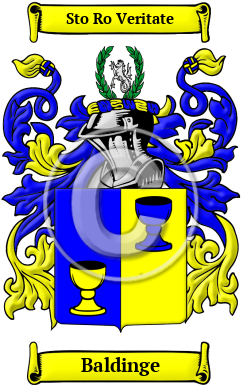
Motto: Sto Ro Veritate
Motto Translation: I stand for the truth.
- Reaney, P.H and R.M. Wilson, A Dictionary of English Surnames. London: Routledge, 1991. Print. (ISBN 0-415-05737-X)
- Bardsley, C.W, A Dictionary of English and Welsh Surnames: With Special American Instances. Wiltshire: Heraldry Today, 1901. Print. (ISBN 0-900455-44-6)
- Rye, Walter, A History of Norfolk. London: Elliot Stock, 62, Paternoster Row, 1885. Print
 |