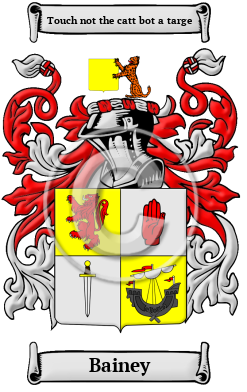
| ![Show Contents]() Bainey History, Family Crest & Coats of Arms Bainey History, Family Crest & Coats of Arms
- Origins Available:
Scotland
Ireland
Etymology of BaineyWhat does the name Bainey mean? The Picts were the ancient Scottish tribe where the ancestors of the Bainey family lived. The name Bainey comes from the Gaelic word Beathan or betha which means life. Bean was also the name of a saint in the Breviary of Aberdeen. Early Origins of the Bainey familyThe surname Bainey was first found in Aberdeen (part of the modern Grampian region), where one of the first times the name arose was a Bean who was a magistrate circa 1210. It is known, however, that the MacBains moved to Invernessshire, as sod bearers to the Chiefs of the great Clan Chattan (a powerful confederation of early Clans). The name literally means "son of the fair lad," and was frequently translated to MacBean (Bain.) Saint Bean or Beyn (fl. 1011), was, according to Fordun, appointed first bishop of Murthlach by Malclom II, at the instance of Pope Benedict VIII. A fragment of the charter of Malcolm II (1003-1029?), preserved in the register of the diocese of Aberdeen confirms this claim. 1 However, St. Bean is distinctly referred to as a native of Ireland: 'In Hybernia natalis Beani primi episcopi Aberdonensis et confessoris'. 1 Early History of the Bainey familyThis web page shows only a small excerpt of our Bainey research. Another 139 words (10 lines of text) covering the years 1400, 1411, 1550 and 1745 are included under the topic Early Bainey History in all our PDF Extended History products and printed products wherever possible. Bainey Spelling VariationsBefore the first dictionaries appeared in the last few hundred years, scribes spelled according to sound. spelling variations are common among Scottish names. Bainey has been spelled Bean, Beane, Beyn, Bayn, Bene, Bane, Baine, Beine, Bayne, Beyne, Been, Beaine, MacBain, MacBean, MacVain, MacBean, MacVan and many more. Early Notables of the Bainey familyMore information is included under the topic Early Bainey Notables in all our PDF Extended History products and printed products wherever possible. Migration of the Bainey family to IrelandSome of the Bainey family moved to Ireland, but this topic is not covered in this excerpt. More information about their life in Ireland is included in all our PDF Extended History products and printed products wherever possible. Migration of the Bainey familyIn those unstable times, many had no choice but to leave their beloved homelands. Sickness and poverty hounded travelers to North America, but those who made it were welcomed with land and opportunity. These settlers gave the young nations of Canada and the United States a strong backbone as they stood up for their beliefs as United Empire Loyalists and in the American War of Independence. In this century, the ancestors of these brave Scots have begun to recover their illustrious heritage through Clan societies and other heritage organizations. Early passenger and immigration lists reveal many Scottish settlers bearing the name Bainey: Alexander Bean who settled in Georgia in 1775; Duncan Bean who settled in Jamaica in 1716; Alexander Bain who settled in Maryland in 1774; John Baine settled in south Carolina in 1716.
The motto was originally a war cry or slogan. Mottoes first began to be shown with arms in the 14th and 15th centuries, but were not in general use until the 17th century. Thus the oldest coats of arms generally do not include a motto. Mottoes seldom form part of the grant of arms: Under most heraldic authorities, a motto is an optional component of the coat of arms, and can be added to or changed at will; many families have chosen not to display a motto.
Motto: Touch not the catt bot a targe
Motto Translation: Touch not the cat without a shield.
- Smith, George (ed), Dictionary of National Biography. London: Smith, Elder & Co., 1885-1900. Print
 |