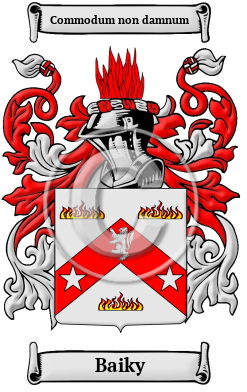
The Baiky family name was first used by descendants of the Pictish people of ancient Scotland. It is a name for someone who lived in the county of Angus at the old manor of Baike.
Loading...
Early Origins of the Baiky family
The surname Baiky was first found in Angus (Gaelic: Aonghas), part of the Tayside region of northeastern Scotland, and present day Council Area of Angus, formerly known as Forfar or Forfarshire, where they held a family seat from very ancient times as Lords of the manor of Baikie. However, by the 14th century this family appears to have moved north to the Orkneys where they became a prominent family.
Early History of the Baiky family
This web page shows only a small excerpt of our Baiky research. Another 81 words (6 lines of text) covering the years 1600, 1697 and 1952 are included under the topic Early Baiky History in all our PDF Extended History products and printed products wherever possible.
Baiky Spelling Variations
Scribes in the Middle Ages did not have access to a set of spelling rules. They spelled according to sound, the result was a great number of spelling variations. In various documents, Baiky has been spelled Backie, Baikie, Bakey, Baikey, Baky, Baickie and others.
Early Notables of the Baiky family
More information is included under the topic Early Baiky Notables in all our PDF Extended History products and printed products wherever possible.
Loading...
Loading...
Loading...
Loading...
Migration of the Baiky family
The cruelties suffered under the new government forced many to leave their ancient homeland for the freedom of the North American colonies. Those who arrived safely found land, freedom, and opportunity for the taking. These hardy settlers gave their strength and perseverance to the young nations that would become the United States and Canada. Immigration and passenger lists have shown many early immigrants bearing the name Baiky: Lennard Baickie who landed in America in 1712.
The motto was originally a war cry or slogan. Mottoes first began to be shown with arms in the 14th and 15th centuries, but were not in general use until the 17th century. Thus the oldest coats of arms generally do not include a motto. Mottoes seldom form part of the grant of arms: Under most heraldic authorities, a motto is an optional component of the coat of arms, and can be added to or changed at will; many families have chosen not to display a motto.
Motto: Commodum non damnum Motto Translation: A convenience not an injury.
Remove Item
WARNING!
Removing this item from your shopping cart will remove your associated sale items.
Are you sure you want to delete this item from your shopping cart?
HouseofNames E-Newsletter Sign Up
On Demand Gifts | Digital Products Available 24/7
A Gift for Everyone on your List is a Click Away - Shop Now