| ![Show Contents]() Aults History, Family Crest & Coats of Arms Aults History, Family Crest & Coats of Arms
Etymology of AultsWhat does the name Aults mean? The age-old Scottish surname Aults was first used by the Strathclyde-Briton people. The Aults family lived at Auld in Ayrshire. Early Origins of the Aults familyThe surname Aults was first found in Ayrshire (Gaelic: Siorrachd Inbhir Àir), formerly a county in the southwestern Strathclyde region of Scotland, that today makes up the Council Areas of South, East, and North Ayrshire, where the surname was recorded as Ealda in an Old English charter of 765. The family continued to prosper in this area for centuries and by 1284, John Alde was listed as servitor of the Earl of Carrick. By 1302 they had also acquired estates in Perthshire. 1 Early History of the Aults familyThis web page shows only a small excerpt of our Aults research. Another 162 words (12 lines of text) covering the years 1477, 1488, 1494, 1501, 1532, 1542, 1635 and 1890 are included under the topic Early Aults History in all our PDF Extended History products and printed products wherever possible. Aults Spelling VariationsIn Medieval times, spelling and translation were not nearly so highly developed as today. They were generally carried out according to the sound and intuition of the bearer. For that reason spelling variations are extremely common among early Scottish names. Aults has been spelled Auld, Alda, Alde, Ald, Aulde, MacAuld and others. Early Notables of the Aults familyMore information is included under the topic Early Aults Notables in all our PDF Extended History products and printed products wherever possible. Migration of the Aults family to IrelandSome of the Aults family moved to Ireland, but this topic is not covered in this excerpt.
Another 61 words (4 lines of text) about their life in Ireland is included in all our PDF Extended History products and printed products wherever possible. Migration of the Aults familyUnrest, poverty, and persecution caused thousands to look for opportunity and freedom in the North American colonies. The crossing was long, overcrowded, and unsanitary, though, and came only at great expense. Many Strathclyde families settled on the east coast of North America in communities that would form the backbone of what would become the great nations of the United States and Canada. The American War of Independence caused those who remained loyal to England to move north to Canada as United Empire Loyalists. In the 20th century, Strathclyde and other Scottish families across North America began to recover their collective heritage through highland games and Clan societies. Among them: Robert Auld of Kilbride who was banished to North America in 1679.
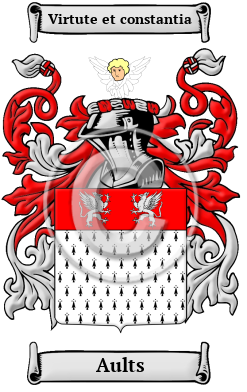
The motto was originally a war cry or slogan. Mottoes first began to be shown with arms in the 14th and 15th centuries, but were not in general use until the 17th century. Thus the oldest coats of arms generally do not include a motto. Mottoes seldom form part of the grant of arms: Under most heraldic authorities, a motto is an optional component of the coat of arms, and can be added to or changed at will; many families have chosen not to display a motto.
Motto: Virtute et constantia
Motto Translation: By courage and perseverance.
- Black, George F., The Surnames of Scotland Their Origin, Meaning and History. New York: New York Public Library, 1946. Print. (ISBN 0-87104-172-3)
 |