| ![Show Contents]() Ross History, Family Crest & Coats of Arms Ross History, Family Crest & Coats of Arms
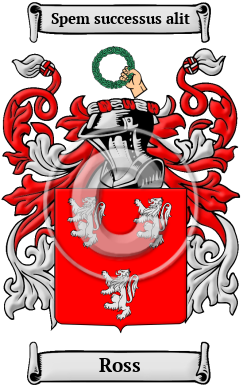
Etymology of RossWhat does the name Ross mean? In the mountains of Scotland's west coast and on the Hebrides islands, the ancestors of the Ross family were born. Their name comes from the given name Andrew, which is derived from Anrias, a progenitor of both the Ross Clan and the MacKenzies. Anrias was descended from the O'Beolans, an Irish Gaelic tribe of the sixth and seventh centuries who first brought Christianity to Scotland. The name may also be a nickname derived from the Old English word rouse, which means red or red-haired. Ross Coat of Arms CreationIn the Ross shield there are three lions, to show that they are of Scottish descent. One branch also had a bend charged with buckles, to show that at one time there must have been an alliance with the Leslies. The crest most commonly used by the Ross Clan is a hand holding a garland of laurel, and the motto, " Spem successus alit " (Success nourishes hope). 1 Early Origins of the Ross familyThe surname Ross was first found in the old monastery of Applecross founded by St. Maelrubha where they were hereditary abbots who later created the Earls of Ross. Their territory was Faster Ross and the first documented Chief was Fearchar Mac ant-Saqairt (a Farquhar), the priest's son, who helped King Alexander II against the old Celtic dynasty. Farquhar joined forces with the King to crush a rebellion in the province of Moray in 1215. Even though he was a direct descendent of the Irish King Niall of the Nine Hostages, he was granted a Norman knighthood by King Alexander and, a few years later, the Earldom of Ross (1234). At this time, Tain, an early shrine created by St. Dutlac, was the capital of Ross. Now a ruin, it played an important role in Scotland's religious history during the Middle Ages. In the late 15th and early 16th century King James IV made annual pilgrimages there. However, battered by its enemies, and many of its relics destroyed by changing religious influences, the capital was transferred to the town of Dingwall. Early History of the Ross familyThis web page shows only a small excerpt of our Ross research. Another 287 words (20 lines of text) covering the years 1372, 1390, 1400, 1600, 1656, 1682, 1715, 1745 and 1890 are included under the topic Early Ross History in all our PDF Extended History products and printed products wherever possible. Ross Spelling VariationsSpelling variations are a very common occurrence in records of early Scottish names. They result from the repeated and inaccurate translations that many names went through in the course of various English occupations of Scotland. Ross has been spelled Ros, Roose, Ross, Ruse and others. Early Notables of the Ross family- William, 5th Earl of Ross (died 1372)
- Sir Andrew Leslie, though before that event, the Chiefship of the Clan passed to Hugh Ross of Rariches who was the progenitor of the Rosses of Balnagowan
- William Ross, 10th Lord Ross of Halkhead (died 1656), a Scottish nobleman
- George Ross, 11th Lord Ross of Halkhead (died 1682), a Scottish nobleman and soldier
Ross World RankingAustralia, the name Ross is the 64th most popular surname with an estimated 35,042 people with that name. 2 However, in New Zealand, the name Ross is ranked the 68th most popular surname with an estimated 4,908 people with that name. 3 And in the United Kingdom, the name Ross is the 106th popular surname with an estimated 44,509 people with that name. 4 Canada ranks Ross as 38th with 43,175 people. 5 Quebec, Canada ranks Ross as 309th. 6 The United States ranks Ross as 80th with 238,752 people. 7 South Africa ranks Ross as 708th with 9,639 people. 8 Migration of the Ross family to IrelandSome of the Ross family moved to Ireland, but this topic is not covered in this excerpt.
Another 60 words (4 lines of text) about their life in Ireland is included in all our PDF Extended History products and printed products wherever possible.
| Ross migration to Australia | + |
Emigration to Australia included the Second Fleet and Third Fleet of convicts, tradespeople and early settlers. Early immigrants include: Following the Second and Third Fleets, other convicts and early settlers arriving in Australia include: Ross Settlers in Australia in the 19th Century- Mr. John Ross, (b. 1785), aged 22, English weaver who was convicted in Shropshire, England for life for highway robbery, transported aboard the "Duke of Portland" in January 1807, arriving in New South Wales, Australia, he died in 1834 10
- Mr. James Ross, Scottish labourer who was convicted in Aberdeen, Scotland for life, transported aboard the "Fanny" on 25th August 1815, arriving in New South Wales, Australia 11
- Miss Ann Ross, (1790 - 1827), aged 27, British settler who was convicted in Lancaster, England for 7 years for stealing handkerchiefs, transported aboard the "Friendship" on 1st May 1817, arriving in New South Wales, Australia 12
- Mr. John Ross, British Convict who was convicted in Inverness, Scotland for 7 years, transported aboard the "Batavia" in October 1817, arriving in New South Wales, Australia 13
- Mr.Thomas Ross, (b. 1798), aged 21, Irish shoe maker who was convicted in Dublin, Ireland for life, transported aboard the "Bencoolen" on 24th April 1819, arriving in New South Wales, Australia before being transferred to Tasmania via the "Admiral Cockburn" 14
- ... (More are available in all our PDF Extended History products and printed products wherever possible.)
| Ross migration to New Zealand | + |
Emigration to New Zealand followed in the footsteps of the European explorers, such as Captain Cook (1769-70): first came sealers, whalers, missionaries, and traders. By 1838, the British New Zealand Company had begun buying land from the Maori tribes, and selling it to settlers, and, after the Treaty of Waitangi in 1840, many British families set out on the arduous six month journey from Britain to Aotearoa to start a new life. Early immigrants include: Ross Settlers in New Zealand in the 19th Century- George Ross, aged 21, a blacksmith, who arrived in Wellington, New Zealand aboard the ship "Blenheim" in 1840
- Robert Ross, aged 23, a baker, who arrived in Wellington, New Zealand aboard the ship "Arab" in 1841
- Mary Ross, aged 21, who arrived in Wellington, New Zealand aboard the ship "Arab" in 1841
- James Ross, aged 37, who arrived in Nelson, New Zealand aboard the ship "Phoebe Dunbar" between 1841 and 1850
- Catherine Ross, aged 36, who arrived in Nelson, New Zealand aboard the ship "Phoebe Dunbar" between 1841 and 1850
- ... (More are available in all our PDF Extended History products and printed products wherever possible.)
| Contemporary Notables of the name Ross (post 1700) | + |
- Diana Ross (b. 1944), American singer, songwriter, and actress, founding member and lead singer of the vocal group The Supremes, inducted to the Rock and Roll Hall of Fame, recipient of the Presidential Medal of Freedom
- James A. "Jim" Ross (1927-2015), former Australian rules footballer for St Kilda (1946-1954)
- Ian "Roscoe" Ross (1940-2014), Australian television news presenter for Seven News in Sydney
- Sir Ian Clunies Ross (1899-1959), Australian veterinary scientist
- Thomas "Tommy" Ross (1946-2017), Scottish professional footballer
- George Ross (1943-2016), Scottish footballer who played from 1960 to 1974 and managed Southport in 1983
- Sir James Clark Ross (1800-1862), British naval officer and explorer, who explored the Arctic with his uncle Sir John Ross and Sir William Parry
- William Ross (1911-1988), Scottish Labour politician
- Ian Ross (1968-2025), Canadian Ojibwe playwright
- ... (Another 37 notables are available in all our PDF Extended History products and printed products wherever possible.)
| Historic Events for the Ross family | + |
- Mr. William Ross (d. 1914), British Greaser from United Kingdom who worked aboard the Empress of Ireland and died in the sinking 15
- Mr. Thomas Ross (1889-1914), American Third Class Passenger from Detroit, Michigan, United States who was traveling aboard the Empress of Ireland and died in the sinking 16
- Miss Eileen Ross (1910-1917), Canadian resident from Halifax, Nova Scotia, Canada who died in the Halifax Explosion (1917) 16
- Master Clifford Ross (1917-1917), Canadian resident from Halifax, Nova Scotia, Canada who died in the Halifax Explosion (1917) 17
- Master Freddie Ross (1912-1917), Canadian resident from Halifax, Nova Scotia, Canada who died in the Halifax Explosion (1917) 17
- ... (Another 32 entries are available in all our PDF Extended History products and printed products wherever possible.)
The motto was originally a war cry or slogan. Mottoes first began to be shown with arms in the 14th and 15th centuries, but were not in general use until the 17th century. Thus the oldest coats of arms generally do not include a motto. Mottoes seldom form part of the grant of arms: Under most heraldic authorities, a motto is an optional component of the coat of arms, and can be added to or changed at will; many families have chosen not to display a motto.
Motto: Spem successus alit
Motto Translation: Success nourishes hope
| Suggested Readings for the name Ross | + |
- The Baron, The Logger, the Miner, and Me by John H. Toole.
- Crossroads in Kansas: A Stearns-Ross Genealogy by Phyllis Ross Kostner.
- History of the Clan Ross by Alexander M. Ross.
- Polson, Alexander, The Romance of Scottish Crests and Mottoes. Inverness: Walter Alexander, Inglis Street 1929. Print
- "Most Common Last Names in Australia." Forebears, https://forebears.io/australia/surnames
- "Most Common Last Names in New Zealand." Forebears, https://forebears.io/new-zealand/surnames
- "UK surname ranking." UK Surname map, https://www.surnamemap.eu/unitedkingdom/surnames_ranking.php?p=10
- "Surnames Meanings, Origins & Distribution Maps - Forebears." Forebears, https://forebears.io/surnames
- "The first 1,000 family names by rank, Quebec (in French only)" Institut de la statistique du Quebec, https://statistique.quebec.ca/en/document/family-names-in-quebec/tableau/the-first-1000-family-names-by-rank-quebec
- "What are the 5,000 Most Common Last Names in the U.S.?". NameCensus.com, https://namecensus.com/last-names/
- "Most Common Last Names in South Africa." Forebears, https://forebears.io/south-africa/surnames
- Convict Records of Australia. Retrieved 4th February 2021 from https://convictrecords.com.au/ships
- Convict Records Voyages to Australia (Retrieved 28th July 2021). Retrieved from https://convictrecords.com.au/ships/duke-of-portland
- Convict Records Voyages to Australia (Retrieved 28th September 2022). https://convictrecords.com.au/ships/fairlie
- Convict Records Voyages to Australia (Retrieved 24th October 2022). https://convictrecords.com.au
- Convict Records Voyages to Australia (Retrieved 30th September 2020). Retrieved from https://convictrecords.com.au/ships/batavia
- Convict Records Voyages to Australia (Retrieved 5th October 2020). Retrieved from https://convictrecords.com.au/ships/bencoolen
- Commemoration Empress of Ireland 2014. (Retrieved 2014, June 17) . Retrieved from http://www.empress2014.ca/seclangen/listepsc1.html
- Halifax Explosion Book of Remembrance | Maritime Museum of the Atlantic. (Retrieved 2014, June 23) . Retrieved from https://maritimemuseum.novascotia.ca/what-see-do/halifax-explosion/halifax-explosion-book-remembrance
 |