| ![Show Contents]() Astlay History, Family Crest & Coats of Arms Astlay History, Family Crest & Coats of Arms
- Origins Available:
England
Etymology of AstlayWhat does the name Astlay mean? The name Astlay is of Anglo-Saxon origin and came from when the family lived in Warwickshire, where they founded the town of Astley. The name is local; a transliteration of the name is east leigh, or east wood. 1 Astley is a district chapelry, in the parish and union of Leigh, hundred of West Derby, S. division of Lancashire. 2 "Astley Hall, or Damhouse, situated in the township of Tyldesley, but on the borders of that of Astley, was built in 1650 by Adam Mort, from whom it has passed to his descendant and present representative, Mrs. Ross, lady of Col. Malcolm Nugent Ross, who has greatly enlarged the mansion." 2 Astley is also a parish, in the union of Martley, Lower division of the hundred of Doddingtree, Hundred-House and W. divisions of the county of Worcester. "An alien priory of Benedictine monks was founded here by Ralph de Todeni, in the reign of William I.; it was annexed to the college of Westbury, in that of Edward IV., and given, at the Dissolution, to Sir Ralph Sadleir." 2 Early Origins of the Astlay familyThe surname Astlay was first found in Warwickshire at Astley, a village and parish within the North Warwickshire district. There are other locals through Britain, but this seems to be local from which the family are descended. The name can be "traced to Philip de Estlega in the 12th of Henry II, and in the female line from the Constables of Melton-Constable, which estate came into the family be the second marriage of Thomas Lord Astley with Edith, third sister and coheir of Geoffrey de Donstable, in the time of Henry II." 3 "A short distance to the north of the church [in Astley, Warwickshire] is a mansion, erected in the sixteenth century, on the site of a more ancient baronial castle: in the interior are a chair and table, which, according to an inscription, were those used by Henry, Marquess Grey and Duke of Suffolk, father of Lady Jane Grey, when concealed in a hollow tree in the vicinity." 2 Astley Castle, the original seat, descended by an heiress to the Greys of Ruthin. Early History of the Astlay familyThis web page shows only a small excerpt of our Astlay research. Another 45 words (3 lines of text) covering the years 1295, 1579, 1595, 1625, 1639, 1642, 1643, 1644, 1652, 1659, 1660, 1662, 1667, 1687, 1688, 1692, 1729, 1739, 1756, 1760, 1772, 1797, 1802, 1817, 1821 and 1859 are included under the topic Early Astlay History in all our PDF Extended History products and printed products wherever possible. Astlay Spelling VariationsIt is only in the last few hundred years that the English language has been standardized. For that reason, early Anglo-Saxon surnames like Astlay are characterized by many spelling variations. As the English language changed and incorporated elements of other European languages, even literate people changed the spelling of their names. Scribes and monks in the Middle Ages spelled names they sounded, so it is common to find several variations that refer to a single person. The variations of the name Astlay include: Astley, Astlee, Astlie, Astly and others. Early Notables of the Astlay familySir Jacob Astley, Lord Astley (1579-1652), English Royalist, the second son of Isaac Astley of Melton Constable, Norfolk. "During the first civil war Astley is a notable figure. He was among those 'hurt' at Edgehill (13 Oct. 1642.) He commanded a division at the siege of Gloucester. When Essex, after relieving that city, had fought the battle of Newbury (20 Sept. 1643), and had continued his retreat to London, Sir Jacob possessed himself of Reading. In 1644 he assisted Lord Hopton in the capture of Arundel (soon retaken by Waller), and shared in the defeat at Alresford (29 March.) " 4
John...
Another 145 words (10 lines of text) are included under the topic Early Astlay Notables in all our PDF Extended History products and printed products wherever possible. Migration of the Astlay familyMany English families tired of political and religious strife left Britain for the new colonies in North America. Although the trip itself offered no relief - conditions on the ships were extremely cramped, and many travelers arrived diseased, starving, and destitute - these immigrants believed the opportunities that awaited them were worth the risks. Once in the colonies, many of the families did indeed prosper and, in turn, made significant contributions to the culture and economies of the growing colonies. An inquiry into the early roots of North American families has revealed a number of immigrants bearing the name Astlay or a variant listed above: Charles Astley who settled in New England in 1684; Henry Astley settled in Philadelphia in 1781; Christopher Astley settled in Newcastle, Del. in 1852..
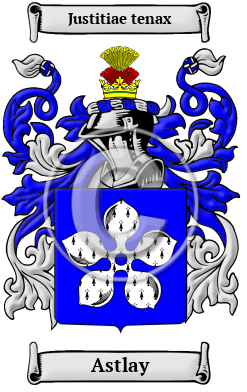
The motto was originally a war cry or slogan. Mottoes first began to be shown with arms in the 14th and 15th centuries, but were not in general use until the 17th century. Thus the oldest coats of arms generally do not include a motto. Mottoes seldom form part of the grant of arms: Under most heraldic authorities, a motto is an optional component of the coat of arms, and can be added to or changed at will; many families have chosen not to display a motto.
Motto: Justitiae tenax
Motto Translation: Justice preserves.
- Mills, A.D., Dictionary of English Place-Names. Oxford: Oxford University Press, 1991. Print. (ISBN 0-19-869156-4)
- Lewis, Samuel, A Topographical Dictionary of England. Institute of Historical Research, 1848, Print.
- Shirley, Evelyn Philip, The Noble and Gentle Men of England; The Arms and Descents. Westminster: John Bower Nichols and Sons, 1866, Print.
- Smith, George (ed), Dictionary of National Biography. London: Smith, Elder & Co., 1885-1900. Print
 |