| ![Show Contents]() Asstel History, Family Crest & Coats of Arms Asstel History, Family Crest & Coats of Arms
- Origins Available:
England
Early Origins of the Asstel familyThe surname Asstel was first found in Northamptonshire at Astwell, a hamlet, partly in the parish of Syresham, but chiefly in the parish of Wapenham, union of Brackley; hundred of King's Sutton. 1 2 While this is the prevailing origin of the name, another credible source notes that the name could have a patronymic name "derived from the name of an ancestor. 'the son of Asketel,' one of the many corruptions of this early and popular name. " 3 Indeed the earliest listings of the family were as both a forename and a surname. The Hundredorum Rolls of 1273 list: Astill filius Wilfriche, Oxfordshire; Astell Propositus, Oxfordshire; William Astil, Oxfordshire; Peter Askyl, Cambridgeshire; Alan Askil, Cambridgeshire; Stephen Astel, Cambridgeshire; and Simon Astil, Buckinghamshire. 3 The History of Norfolk listed Hugh Astel, as rector of Aylmerton, Norfolk, 1371; and Nicholas Astell, as vicar of Stradset, Norfolk, 1450. 4 We would be remiss if we did not mention the Cornish branch of the family. St, Austell was their home, a parish, which is situated in the east division of the hundred of Powder. "There are few parishes in Cornwall, on the origin of whose name more doubts have been entertained. From this place was denominated an old family of gentlemen, De Austell, of which family William de Austell was sheriff of Cornwall in the reign of Edward III. which was prior to the middle of the fourteenth century. His grandson John de Austell was also sheriff of the county in the twenty-fifth of Henry VI. ; and in the two following years he enjoyed the same honours for Somerset and Dorset." 5 Early History of the Asstel familyThis web page shows only a small excerpt of our Asstel research. Another 178 words (13 lines of text) covering the years 1225, 1349, 1379, 1532, 1641, 1668, 1675, 1697, 1714, 1722, 1731, 1735, 1800, 1807, 1841 and 1847 are included under the topic Early Asstel History in all our PDF Extended History products and printed products wherever possible. Asstel Spelling VariationsUntil quite recently, the English language has lacked a definite system of spelling rules. Consequently, Anglo-Saxon surnames are characterized by a multitude of spelling variations. Changes in Anglo-Saxon names were influenced by the evolution of the English language, as it incorporated elements of French, Latin, and other languages. Although Medieval scribes and church officials recorded names as they sounded, so it is common to find one person referred to by several different spellings of his surname, even the most literate people varied the spelling of their own names. Variations of the name Asstel include Astell, Astel, Astill, Astil, Asstel, Asstil, Asthul, Asthule, Astle, Atsell and many more. Early Notables of the Asstel familySir Henry Hatsell (1641-1714), English judge, son of Henry Hatsell of Saltram, in the parish of Plympton St. Mary, Devonshire. 6
William Astell, (d. 1847) was elected to the court of directors of the East India Company in 1800 and served on it for an unprecedented period of 47...
Another 47 words (3 lines of text) are included under the topic Early Asstel Notables in all our PDF Extended History products and printed products wherever possible. Migration of the Asstel familySearching for a better life, many English families migrated to British colonies. Unfortunately, the majority of them traveled under extremely harsh conditions: overcrowding on the ships caused the majority of the immigrants to arrive diseased, famished, and destitute from the long journey across the ocean. For those families that arrived safely, modest prosperity was attainable, and many went on to make invaluable contributions to the development of the cultures of the new colonies. Research into the origins of individual families in North America revealed records of the immigration of a number of people bearing the name Asstel or a variant listed above: Mary Astell, who sailed to Maryland in 1726. In Canada John Astle was recorded in Ontario in 1830 and Joseph Astel was living in Wellington County, Ontario in 1871..
The motto was originally a war cry or slogan. Mottoes first began to be shown with arms in the 14th and 15th centuries, but were not in general use until the 17th century. Thus the oldest coats of arms generally do not include a motto. Mottoes seldom form part of the grant of arms: Under most heraldic authorities, a motto is an optional component of the coat of arms, and can be added to or changed at will; many families have chosen not to display a motto.
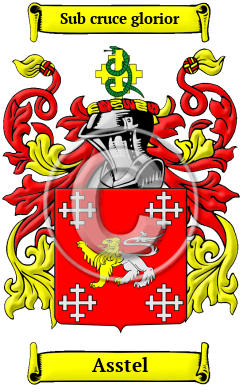
Motto: Sub cruce glorior
Motto Translation: I glorify under the cross.
- Lewis, Samuel, A Topographical Dictionary of England. Institute of Historical Research, 1848, Print.
- Barber, Henry, British Family Names London: Elliot Stock, 62 Paternoster Row, 1894. Print.
- Bardsley, C.W, A Dictionary of English and Welsh Surnames: With Special American Instances. Wiltshire: Heraldry Today, 1901. Print. (ISBN 0-900455-44-6)
- Rye, Walter, A History of Norfolk. London: Elliot Stock, 62, Paternoster Row, 1885. Print
- Hutchins, Fortescue, The History of Cornwall, from the Earliest Records and Traditions to the Present Time. London: William Penaluna, 1824. Print
- Smith, George (ed), Dictionary of National Biography. London: Smith, Elder & Co., 1885-1900. Print
 |