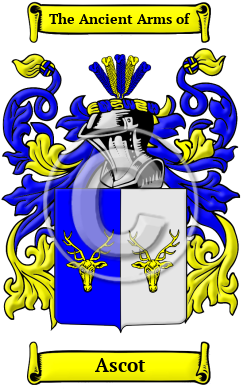
| ![Show Contents]() Ascot History, Family Crest & Coats of Arms Ascot History, Family Crest & Coats of Arms
- Origins Available:
England
Etymology of AscotWhat does the name Ascot mean? The Ascot history begins in Cornwall, a rugged coastal region in southwestern England. Quite distinct from Devon, the adjoining county, Cornwall had its own spoken language until the late 18th century. The Ascot history began here. The manner in which hereditary surnames arose is interesting. Local surnames were derived from where the original bearer lived, was born, or held land. Unlike most Celtic peoples, who favored patronymic names, the Cornish predominantly used local surnames. The Ascot family originally lived in Arscott, in Devon and perhaps Arscott in Shropshire (Salop.) Alternatively, the Ascott variant, derived from the Old English words "east" + "cot," meaning "eastern cottages," 1 can be found in Berkshire, Warwickshire, Buckinghamshire and Oxfordshire. 2 The Berkshire parish is the oldest, dating back to 1177 when it was known as Estcota. Ascott-under-Wychwood in Oxfordshire literally means "near the forest of Wynchwood." 1 Early Origins of the Ascot familyThe surname Ascot was first found in Devon, where "Tetcott was the last seat of the family of Arscott, who died out in the male line in 1788." 3 Other early records include: William de Ardescote who was listed in the Hundredorum Rolls of 1255 in Shropshire. William de Hassecote was found in Cornwall in 1201. 4 As far as the Ascott variant, the first record was Richard de Askote in 1375. 4 Early History of the Ascot familyThis web page shows only a small excerpt of our Ascot research. Another 82 words (6 lines of text) covering the years 1554, 1588, 1603, 1613, 1618, 1656, 1675, 1683, 1718, 1722, 1747, 1762 and 1788 are included under the topic Early Ascot History in all our PDF Extended History products and printed products wherever possible. Ascot Spelling VariationsCornish surnames are characterized by a multitude of spelling variations. The frequent changes in surnames are due to the fact that the Old and Middle English languages lacked definite spelling rules. The official court languages, which were Latin and French, were also influential on the spelling of a surname. Since the spelling of surnames was rarely consistent in medieval times, and scribes and church officials recorded names as they sounded rather than adhering to any specific spelling rules, it was common to find the same individual referred to with different spellings of their surname in the ancient chronicles. Moreover, a large number of foreign names were brought into England, which accelerated and accentuated the alterations to the spelling of various surnames. Lastly, spelling variations often resulted from the linguistic differences between the people of Cornwall and the rest of England. The Cornish spoke a unique Brythonic Celtic language which was first recorded in written documents during the 10th century. However, they became increasingly Anglicized, and Cornish became extinct as a spoken language in 1777, although it has been revived by Cornish patriots in the modern era. The name has been spelled Arscot, Ascot, Arscott, Ascott, Asscot, Asscott and others. Early Notables of the Ascot familyArthur Arscott (1683-1762) of Tetcott, Devon, a British landowner and politician who sat in the House of Commons from 1722 to 1747.
John Arscott (1613-1675), of Tetcott, Devon, was Sheriff of Devon in 1675. He was the eldest son and heir of Edmund Arscott (1588-1656), of Tetcott. Arthur...
Another 48 words (3 lines of text) are included under the topic Early Ascot Notables in all our PDF Extended History products and printed products wherever possible. Migration of the Ascot familyIn the immigration and passenger lists were a number of people bearing the name Ascot Patrick Ascott who settled in Virginia in 1653; John Ascott settled in New York, NY in 1661; William settled in Charles Town [Charleston], South Carolina in 1823..
- Mills, A.D., Dictionary of English Place-Names. Oxford: Oxford University Press, 1991. Print. (ISBN 0-19-869156-4)
- Lewis, Samuel, A Topographical Dictionary of England. Institute of Historical Research, 1848, Print.
- Worth, R.N., A History of Devonshire London: Elliot Stock, 62, Paternoster Row, E.G., 1895. Digital
- Reaney, P.H and R.M. Wilson, A Dictionary of English Surnames. London: Routledge, 1991. Print. (ISBN 0-415-05737-X)
 |