| ![Show Contents]() Angier History, Family Crest & Coats of Arms Angier History, Family Crest & Coats of Arms
Etymology of AngierWhat does the name Angier mean? The Angier surname is an old name from Normandy. It comes from when the family lived in the former province of Anjou, which comprised parts of southern Armorica, Indre-et-Loire, and Sarthe. The ancient capital of Anjou was Angers and, from the 10th century, this region was a countship belonging to the Plantagenet dynasty. Anjou was attached to the English Crown in 1156, after Henry II, the son of the Count of Anjou, became King of England. However, the territory was recovered by Philippe II in 1206 and, in 1487, the province was secured as Crown land by the French Crown. Early Origins of the Angier familyThe surname Angier was first found in Normandy (French: Normandie), the former Duchy of Normandy, where the family held a family seat from ancient times. Some of the family emigrated to England as in the Domesday Book of 1086, "several of the name are found. The principal land-owner among them, who is supposed to have been of Breton origin, held considerable estates in Devonshire under Baldwin de Meules." 1 "John de Aunger served as knight of the shire for Leicester in three of Edward I.'s parliaments, and in the first held by Edward II. Josceline D'Aunger in 1169 witnessed the foundation charter of Lanercost Abbey, and Ralph de Angers in the thirteenth century held lands in Wilts. Ralph de Aungers was Sheriff of Notts, 49 and 50 Henry III. " 1 Early History of the Angier familyThis web page shows only a small excerpt of our Angier research. Another 264 words (19 lines of text) covering the years 1060, 1083, 1568, 1629, 1634, 1638 and 1720 are included under the topic Early Angier History in all our PDF Extended History products and printed products wherever possible. Angier Spelling VariationsThe many different spellings of French surnames can be partially explained by the use of local dialects and by the influence of other languages during the early development of the French language. As a result of these linguistic and cultural influences, the name Angier is distinguished by a number of regional variations. The many spelling variations of the name include Anger, Angers, Angier, Ange, Dange, d'Angeros, Dangeros, d'Anger, d'Ange, d'Angier, d'Angers, Anget, Angay, Angey, Angé, d'Anget, d'Angay, d'Angey, d'Angé, Angger, Anggers, Anggier, d'Angger, d'Anggers, d'Anggier, Ager, Agey, d'Agey, Ageais, d'Ageais, Aggeais, Lange, Angerot, Dangerot, d'Angerot and many more. Early Notables of the Angier familyAnother 47 words (3 lines of text) are included under the topic Early Angier Notables in all our PDF Extended History products and printed products wherever possible.
| Angier migration to the United States | + |
By 1643 there were only about 300 people in Quebec. Since immigration was slow, early marriage was desperately encouraged amongst the immigrants. The fur trade attracted migrants, both noble and commoner. 15,000 explorers left Montreal in the late 17th and 18th centuries. By 1675, there were 7000 French in Quebec. By the same year the Acadian presence in Nova Scotia, New Brunswick and Prince Edward Island had reached 500. In 1755, 10,000 French Acadians refused to take an oath of allegiance to England and were deported to Louisiana. The French founded Lower Canada, thus becoming one of the two great founding nations of Canada. The distinguished family name Angier has made significant contributions to the culture, arts, sciences and religion of France and New France. Amongst the settlers in North America with this distinguished name Angier were
Angier Settlers in United States in the 17th Century- Edmund Angier, who landed in Cambridge, Massachusetts in 1636 2
- John Angier, who landed in Boston, Massachusetts in 1651 2
- Samson Angier, who landed in New England in 1652 2
- Sampson Angier, who landed in Maine in 1653 2
- Samuel Angier, who arrived in Massachusetts in 1673 2
- ... (More are available in all our PDF Extended History products and printed products wherever possible.)
Angier Settlers in United States in the 19th Century- Robert Angier, who arrived in Massachusetts in 1838 2
| Angier migration to New Zealand | + |
Emigration to New Zealand followed in the footsteps of the European explorers, such as Captain Cook (1769-70): first came sealers, whalers, missionaries, and traders. By 1838, the British New Zealand Company had begun buying land from the Maori tribes, and selling it to settlers, and, after the Treaty of Waitangi in 1840, many British families set out on the arduous six month journey from Britain to Aotearoa to start a new life. Early immigrants include: Angier Settlers in New Zealand in the 19th Century- Mr. Robert Angier, Scottish settler travelling from Glasgow aboard the ship "Bruce" arriving in Dunedin, South Island, New Zealand on 12th September 1860 3
| Contemporary Notables of the name Angier (post 1700) | + |
- Bradford Angier (1910-1997), American author and survivalist
- Nedom L. Angier (1814-1882), American politician
- Natalie Angier (b. 1958), American writer and journalist for the New York Times
- Robert E. Angier, American politician, Delegate to New Hampshire State Constitutional Convention from Claremont 2nd Ward, 1948 4
- Nedom L. Angier, American politician, Mayor of Atlanta, Georgia, 1877-79 5
- John C. Angier (1857-1911), American Republican politician, Alternate Delegate to Republican National Convention from North Carolina, 1908 5
- Joel N. Angier, American politician, Mayor of Titusville, Pennsylvania, 1866-67 5
- Edgar A. Angier, American politician, U.S. Attorney for the Northern District of Georgia, 1897-1905 5
- E. L. Angier, American Republican politician, Alternate Delegate to Republican National Convention from Texas, 1912 5
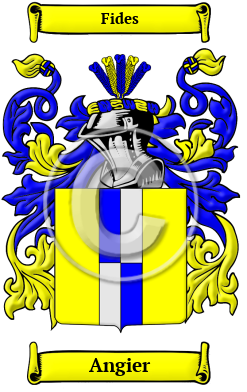
The motto was originally a war cry or slogan. Mottoes first began to be shown with arms in the 14th and 15th centuries, but were not in general use until the 17th century. Thus the oldest coats of arms generally do not include a motto. Mottoes seldom form part of the grant of arms: Under most heraldic authorities, a motto is an optional component of the coat of arms, and can be added to or changed at will; many families have chosen not to display a motto.
Motto: Fides
Motto Translation: Faith.
- Cleveland, Dutchess of The Battle Abbey Roll with some Account of the Norman Lineages. London: John Murray, Abermarle Street, 1889. Print. Volume 1 of 3
- Filby, P. William, Meyer, Mary K., Passenger and immigration lists index : a guide to published arrival records of about 500,000 passengers who came to the United States and Canada in the seventeenth, eighteenth, and nineteenth centuries. 1982-1985 Cumulated Supplements in Four Volumes Detroit, Mich. : Gale Research Co., 1985, Print (ISBN 0-8103-1795-8)
- New Zealand Yesteryears Passenger Lists 1800 to 1900 (Retrieved 17th October 2018). Retrieved from http://www.yesteryears.co.nz/shipping/passlist.html
- The Political Graveyard: Alphabetical Name Index. (Retrieved 2015, November 23) . Retrieved from http://politicalgraveyard.com/alpha/index.html
 |