| ![Show Contents]() Ancrum History, Family Crest & Coats of Arms Ancrum History, Family Crest & Coats of Arms
- Origins Available:
Scotland
England
Etymology of AncrumWhat does the name Ancrum mean? In ancient Scotland, Ancrum was a Strathclyde-Briton name for someone who lived in Roxburghshire (Borders) at Ancrum, a small village which had earlier been called Alncromb, which literally meant "a bend in the river Ale." Early Origins of the Ancrum familyThe surname Ancrum was first found in Dumbartonshire, where they held a family seat in the lands of Ancrum from about the 11th century. "In 1252 John of Alnecromb appears as witness to a charter by Richard Burnard of Farningham to the monks of Melrose. In 1296 a writ was issued to the sheriff of Roxburgh, ordering him to restore to Richard de Alnecrum his forfeited lands. John de Allyncrum, was Clerk of Register and auditor of accounts in 1358. John de Allynerom, a Scottish merchant, who received in 1361 a safe conduct to England from Edward III is doubtless John of Allyncrum, a prominent burgess of Edinburgh, who, c. 1362, granted his lands of Crageroke to the Church of St. Giles, Edinburgh." 1 Early History of the Ancrum familyThis web page shows only a small excerpt of our Ancrum research. Another 142 words (10 lines of text) covering the years 1296, 1358, 1361, 1370, 1567, 1684 and 1781 are included under the topic Early Ancrum History in all our PDF Extended History products and printed products wherever possible. Ancrum Spelling VariationsPrior to the first dictionaries, scribes spelled words according to sound. This, and the fact that Scottish names were repeatedly translated from Gaelic to English and back, contributed to the enormous number of spelling variations in Scottish names. Ancrum has been spelled Ancram, Ancrum, Ancrumb, Anckrum, Ancromb, Allyncrum, Alncrum, Alyncrome, Allyncom and many more. Early Notables of the Ancrum familyMore information is included under the topic Early Ancrum Notables in all our PDF Extended History products and printed products wherever possible.
| Ancrum migration to the United States | + |
In such difficult times, the difficulties of raising the money to cross the Atlantic to North America did not seem so large compared to the problems of keeping a family together in Scotland. It was a journey well worth the cost, since it was rewarded with land and freedom the Scots could not find at home. The American War of Independence solidified that freedom, and many of those settlers went on to play important parts in the forging of a great nation. Among them:
Ancrum Settlers in United States in the 17th Century- Charles Ancrum, who landed in Virginia in 1664 2
Ancrum Settlers in United States in the 18th Century- William Ancrum, aged 26, who arrived in Charleston, South Carolina in 1740 2
- William Ancrum who settled in Charles Town [Charleston], South Carolina in 1766
| Contemporary Notables of the name Ancrum (post 1700) | + |
- David Chalton Ancrum (b. 1958), American retired professional and college basketball player
- William Ancrum (1722-1808), early American merchant and indigo planter from Charleston, South Carolina who served in the Third General Assembly during the Revolutionary War
- Rear Admiral John Ancrum Winslow (1811-1873), American naval officer during the Mexican-American War and the American Civil War, eponym of the USS Winslow, a United States Navy torpedo boat and the USS Winslow (DD-359/AG-127), a Porter-class destroyer
- Molton Ancrum Shuler, American politician, Member of South Carolina State Senate from Williamsburg County, 1935-38 3
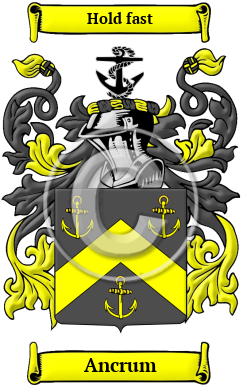
The motto was originally a war cry or slogan. Mottoes first began to be shown with arms in the 14th and 15th centuries, but were not in general use until the 17th century. Thus the oldest coats of arms generally do not include a motto. Mottoes seldom form part of the grant of arms: Under most heraldic authorities, a motto is an optional component of the coat of arms, and can be added to or changed at will; many families have chosen not to display a motto.
Motto: Hold fast
- Black, George F., The Surnames of Scotland Their Origin, Meaning and History. New York: New York Public Library, 1946. Print. (ISBN 0-87104-172-3)
- Filby, P. William, Meyer, Mary K., Passenger and immigration lists index : a guide to published arrival records of about 500,000 passengers who came to the United States and Canada in the seventeenth, eighteenth, and nineteenth centuries. 1982-1985 Cumulated Supplements in Four Volumes Detroit, Mich. : Gale Research Co., 1985, Print (ISBN 0-8103-1795-8)
- The Political Graveyard: Alphabetical Name Index. (Retrieved 2015, October 14) . Retrieved from http://politicalgraveyard.com/alpha/index.html
 |