| ![Show Contents]() Amys History, Family Crest & Coats of Arms Amys History, Family Crest & Coats of Arms
Etymology of AmysWhat does the name Amys mean? Amys is a name whose history begins in 1066 with the Norman Conquest of England. This Norman name was used for a good friend or beloved one. The name was originally derived from the Old French given name or nickname Amis or Ami, which means friend. Alternatively the name could have been derived from the "descendant of Amos (burden-bearer.)" 1 Early Origins of the Amys familyThe surname Amys was first found in the county of Northumberland, where they were granted lands by King William after the Norman Conquest in 1066. They originated from Exmes, a town in the department of Orne, in Normandy. 2 "Amos, like Amias or Amyas, represents popular forms of the Norman-French Aimee, or Amys. " 3 Kirby's Quest had the first listing for the family: Thomas Amys, Somerset, 1 Edward III (during the first year of King Edward III's reign.) 4 Another sources notes: "the present family of Amos, established in the Faversham district, [in Kent] probably can claim an ancestor in Thomas Amos, a well - to - do yeoman of Ospringe, who in 1769 bequeathed £100 for the poor of Molash." 5 Early History of the Amys familyThis web page shows only a small excerpt of our Amys research. Another 178 words (13 lines of text) covering the years 1576, 1619, 1633, 1640, 1641, 1689, 1692, 1693, 1695, 1721, 1759, 1864 and 1889 are included under the topic Early Amys History in all our PDF Extended History products and printed products wherever possible. Amys Spelling VariationsA multitude of spelling variations characterize Norman surnames. Many variations occurred because Old and Middle English lacked any definite spelling rules. The introduction of Norman French to England also had a pronounced effect, as did the court languages of Latin and French. Therefore, one person was often referred to by several different spellings in a single lifetime. The various spellings include Ames, Amess, Amies, Amis, Amiss, Amos, Hames, Haymes, Eames, Emmes and many more. Early Notables of the Amys familyWilliam Ames (Latin: Guilielmus Amesius) (1576-1633), an English Protestant divine, philosopher, and controversialist.
Henry Metcalfe Ames, of Lynden Hall, Northumberland was High Sheriff of Northumberland in 1864.
Joseph Ames (1619-1695), was an English naval commander from Norfolk who commanded several ships of war, and made repeated voyages to America and the West Indies transporting Royalist prisoners. Joseph Ames (1689-1759), was an...
Another 59 words (4 lines of text) are included under the topic Early Amys Notables in all our PDF Extended History products and printed products wherever possible. Migration of the Amys family to IrelandSome of the Amys family moved to Ireland, but this topic is not covered in this excerpt.
Another 43 words (3 lines of text) about their life in Ireland is included in all our PDF Extended History products and printed products wherever possible. Migration of the Amys familyMany English families left England, to avoid the chaos of their homeland and migrated to the many British colonies abroad. Although the conditions on the ships were extremely cramped, and some travelers arrived diseased, starving, and destitute, once in the colonies, many of the families prospered and made valuable contributions to the cultures of what would become the United States and Canada. Research into the origins of individual families in North America has revealed records of the immigration of a number of people bearing the name Amys or a variant listed above: Abraham Ames who settled in Virginia in 1663; Joan Ames settled in Boston, in 1637; John Ames settled in Virginia in 1663; William Ames settled in Boston in 1637.
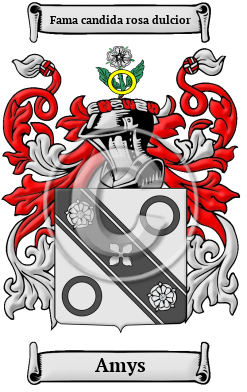
The motto was originally a war cry or slogan. Mottoes first began to be shown with arms in the 14th and 15th centuries, but were not in general use until the 17th century. Thus the oldest coats of arms generally do not include a motto. Mottoes seldom form part of the grant of arms: Under most heraldic authorities, a motto is an optional component of the coat of arms, and can be added to or changed at will; many families have chosen not to display a motto.
Motto: Fama candida rosa dulcior
Motto Translation: Fame is sweeter than the white rose.
- Smith, Eldson Coles, New Dictionary of American Family Names New York: Harper & Row, 1956. Print
- The Norman People and Their Existing Descendants in the British Dominions and the United States Of America. Baltimore: Genealogical Publishing, 1975. Print. (ISBN 0-8063-0636-X)
- Bardsley, C.W, A Dictionary of English and Welsh Surnames: With Special American Instances. Wiltshire: Heraldry Today, 1901. Print. (ISBN 0-900455-44-6)
- Dickinson, F.H., Kirby's Quest for Somerset of 16th of Edward the 3rd London: Harrison and Sons, Printers in Ordinary to Her Majesty, St, Martin's Lane, 1889. Print.
- Guppy, Henry Brougham, Homes of Family Names in Great Britain. 1890. Print.
 |