| ![Show Contents]() Andertun History, Family Crest & Coats of Arms Andertun History, Family Crest & Coats of Arms
- Origins Available:
England
Etymology of AndertunWhat does the name Andertun mean? Of all the Anglo-Saxon names to come from Britain, Andertun is one of the most ancient. The name is a result of the original family having lived in a township and estate by the name of Anderton in the county of Lancashire, located north of Ince on the coast north of Liverpool. Early Origins of the Andertun familyThe surname Andertun was first found in Lancashire from very ancient times, they being from the town of Anderton in that county, located north of Ince on the coast north of Liverpool. "This place gave name to a family which was seated here at an early period; it comprises about 800 acres, and has coal-mines, and good stone-quarries." 1 One of the more famous branches held Euxton Hall at Euxton in Lancashire. "Over the portal, and also on two old chimneypieces in the house, are to be seen the arms of the Molyneuxs and Andertons quartered; William Anderton, Esq., having married Mary, daughter of the fifth viscount Molyneux. The ceilings of the entrance-hall and staircase, richly ornamented by Concillio, are in good preservation, and the mansion has been considerably altered and enlarged by William Ince Anderton, Esq., the present possessor." 1 Early History of the Andertun familyThis web page shows only a small excerpt of our Andertun research. Another 58 words (4 lines of text) covering the years 1557, 1560, 1577, 1586, 1611, 1615, 1618, 1628, 1630, 1643, 1657, 1667, 1671, 1677, 1678, 1680, 1690, 1691, 1705, 1710, 1715, 1724 and 1760 are included under the topic Early Andertun History in all our PDF Extended History products and printed products wherever possible. Andertun Spelling VariationsThe first dictionaries that appeared in the last few hundred years did much to standardize the English language. Before that time, spelling variations in names were a common occurrence. The language was changing, incorporating pieces of other languages, and the spelling of names changed with it. Andertun has been spelled many different ways, including Anderton, Andertone, Andeton and others. Early Notables of the Andertun familyJames Anderton (1557-1618) an English Catholic aristocrat who held Lostock Hall, Lostock. Laurence Anderton, alias Scroop (1577-1643), was a learned English Jesuit. Of the same stock, he was son of Thomas Anderton, of Horwich, and brother of Christopher Anderton, of Lostock. Robert Anderton (c. 1560-1586) was an English Roman Catholic priest and martyr. He and his close friend William Marsden were taken to the Isle of Wight near the spot where they had landed and executed by hanging, drawing, and quartering on 25 April 1586.
Thomas Anderton (1611-1671), was an English Benedictine, sixth son of William Anderton, Esq., of Euxton. Henry...
Another 154 words (11 lines of text) are included under the topic Early Andertun Notables in all our PDF Extended History products and printed products wherever possible. Migration of the Andertun familyThousands of English families in this era began to emigrate the New World in search of land and freedom from religious and political persecution. Although the passage was expensive and the ships were dark, crowded, and unsafe, those who made the voyage safely were rewarded with opportunities unavailable to them in their homeland. Research into passenger and immigration lists has revealed some of the very first Andertuns to arrive in North America: John Anderton, who settled in Virginia in 1651; George Anderton, who settled in Barbados in 1667; John Anderton, who settled in Nevis in 1663; Mary Anderton, who settled in Maryland in 1690.
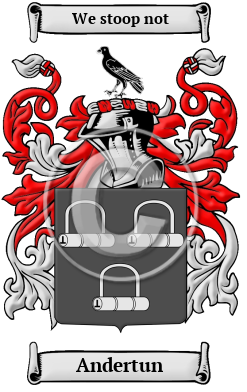
The motto was originally a war cry or slogan. Mottoes first began to be shown with arms in the 14th and 15th centuries, but were not in general use until the 17th century. Thus the oldest coats of arms generally do not include a motto. Mottoes seldom form part of the grant of arms: Under most heraldic authorities, a motto is an optional component of the coat of arms, and can be added to or changed at will; many families have chosen not to display a motto.
Motto: We stoop not
- Lewis, Samuel, A Topographical Dictionary of England. Institute of Historical Research, 1848, Print.
 |