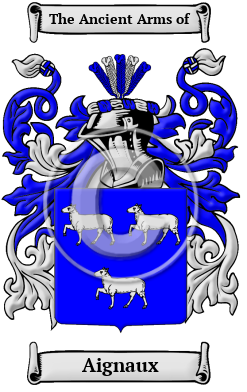
| ![Show Contents]() Aignaux History, Family Crest & Coats of Arms Aignaux History, Family Crest & Coats of Arms
Etymology of AignauxWhat does the name Aignaux mean? The name Aignaux has a long French heritage that first began in the northern region of Normandy. The name is derived from when the family lived in the diocese of Coutances, in Normandy. 1 Early Origins of the Aignaux familyThe surname Aignaux was first found in Normandy (French: Normandie), the former Duchy of Normandy, where they held a family seat at Aigneaux in the diocese of Coutances in Rouen, and were members of the aristocracy of that region. The first of this name on record was Herbert D'Aigneaux who was descended from the Vicomte Caen in the Cotentin. The family gave its name to the parish of Aigneaux. It is assumed that Herbert joined the Duke of Normandy in his conquest of England in 1066 A.D. Sometime before 1074 Herbert sold part of his estates to Bishop Odo of Bayeux, and also purchased other lands from Corbin, his son. The Aigneaux family had a very important barony consisting of many fiefs along the River Lavire for seven miles, together with St.-Contest at Amfreville on the island of Marie. They were the benefactors of many religious establishments. Early History of the Aignaux familyThis web page shows only a small excerpt of our Aignaux research. Another 80 words (6 lines of text) covering the years 1680 and 1736 are included under the topic Early Aignaux History in all our PDF Extended History products and printed products wherever possible. Aignaux Spelling VariationsFrench surnames were subject to numerous spelling alterations depending on the region and time it was used. The early development of the French language relied heavily on borrowing elements and grammar from other languages. For example, Old French was infused with Germanic words and sounds when barbarian tribes invaded and settled in France after the fall of the Roman Empire. Middle French also borrowed heavily from the Italian language during the Renaissance. As a result of these linguistic and cultural influences, the name Aignaux is distinguished by a number of regional variations. The many spelling variations of the name include Daignault, D'Aigneau, Daigneau, Daignaux, D'Aiognaux, Daignaud, D'Aignaud, D'Aignault, D'Aigneaux, Daigneaux, Deneau, Deneault, Denyau, Denais, Deinout, Deinieau, Denault, Denaut, Denaux, Deneux, Denieau, Daieneault, D'Aieneault, Daineau, D'Aineau, Aignault and many more. Early Notables of the Aignaux familyMore information is included under the topic Early Aignaux Notables in all our PDF Extended History products and printed products wherever possible. Migration of the Aignaux familyIn the 1700s, land incentives were finally given out by France to 2,000 migrants. Early marriage was encouraged in New France, and youths of 18 took fourteen-year-old girls for their wives. The fur trade was developed and attracted migrants, both noble and commoner from France. 15,000 explorers left Montreal in the late 17th and 18th centuries, leaving French names scattered across the continent. The search for the Northwest passage continued. Migration from France to New France or Quebec, as it was now more popularly called, continued until 1759. By 1675, there were 7000 French in Quebec. By the same year the Acadian presence in Nova Scotia, New Brunswick and Prince Edward Island had reached 500. In the treaty of Utrecht, Acadia were ceded by France to Britain in 1713. In 1755, 10,000 French Acadians refused to take an oath of allegiance to England and were deported. They found refuge in Louisiana. Meanwhile, in Quebec, the French race flourished, founding in Lower Canada, one of the two great solitudes which became Canada. Many of this distinguished family name Aignaux were prominent in social, cultural, religious and political affairs in France and New France. Amongst the settlers in North America with this distinguished name Aignaux were Jean Daignault settled in Quebec in 1665 from Brittany; Claude Denault arrived in Quebec in 1686 from Ile-de-France; Jacques Denault arrived in Quebec in 1740 from Normandy.
- The Norman People and Their Existing Descendants in the British Dominions and the United States Of America. Baltimore: Genealogical Publishing, 1975. Print. (ISBN 0-8063-0636-X)
 |