| ![Show Contents]() Allens History, Family Crest & Coats of Arms Allens History, Family Crest & Coats of Arms
Etymology of AllensWhat does the name Allens mean? While the majority of the bearers of Allens in Ireland are of English or Scottish origins, there were indigenous Irish bearers of Allens, who derived their name from the Gaelic "O hAilin." Early Origins of the Allens familyThe surname Allens was first found in Ulster (Irish: Ulaidh). Probably one of the best known early representatives of the family was John Allen (Alen) (1476-1534), Archbishop of Dublin whose early "Register" is still known as a very valuable source of medieval life in Ireland. He became Lord Chancellor but was assassinated by Lord Thomas FitzGerald's followers. At this time there was also another group located on the borders of Mayo and Roscommon. Early History of the Allens familyThis web page shows only a small excerpt of our Allens research. Another 80 words (6 lines of text) covering the years 1652, 1848 and 1867 are included under the topic Early Allens History in all our PDF Extended History products and printed products wherever possible. Allens Spelling VariationsSpelling variations of this family name include: MacEllin, Hallion, Alen, MacAilin, MacEllen and many more. Early Notables of the Allens familyMore information is included under the topic Early Allens Notables in all our PDF Extended History products and printed products wherever possible.
| Allens migration to Australia | + |
Allens Settlers in Australia in the 19th Century- Mr. William Allens, (b. 1803), aged 43, Cornish settler convicted in Bodmin, Cornwall, UK on 25th March 1846, sentenced for 10 years for housebreaking and stealing gown pieces at St. Agnes, transported aboard the ship "Cornwall" on 24th February 1851 to Van Dieman's Land, Tasmania, Australia 1
- Mr. William Allens, Cornish convict who was convicted in Bodmin, Cornwall, England for 10 years, transported aboard the "Cornwall" on 28th February 1851, arriving in Tasmania (Van Diemen's Land) 2
- Arthur Allens, aged 30, a labourer, who arrived in South Australia in 1856 aboard the ship "Switzerland"
| Historic Events for the Allens family | + |
Cataraqui - Thomas Allens (b. 1814), British passenger who died aboard the ship "Cataraqui" when sailing for Melbourne, Australia she struck rocks of Kings Island and sank on 4th April 1845
- Anne Allens (b. 1816), British passenger who died aboard the ship "Cataraqui" when sailing for Melbourne, Australia she struck rocks of Kings Island and sank on 4th April 1845
- Elizabeth Allens (b. 1838), British passenger who died aboard the ship "Cataraqui" when sailing for Melbourne, Australia she struck rocks of Kings Island and sank on 4th April 1845
- Susan Allens (b. 1840), British passenger who died aboard the ship "Cataraqui" when sailing for Melbourne, Australia she struck rocks of Kings Island and sank on 4th April 1845
- Alice Allens (b. 1842), British passenger who died aboard the ship "Cataraqui" when sailing for Melbourne, Australia she struck rocks of Kings Island and sank on 4th April 1845
- ... (Another 5 entries are available in all our PDF Extended History products and printed products wherever possible.)
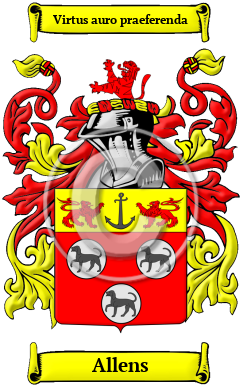
The motto was originally a war cry or slogan. Mottoes first began to be shown with arms in the 14th and 15th centuries, but were not in general use until the 17th century. Thus the oldest coats of arms generally do not include a motto. Mottoes seldom form part of the grant of arms: Under most heraldic authorities, a motto is an optional component of the coat of arms, and can be added to or changed at will; many families have chosen not to display a motto.
Motto: Virtus auro praeferenda
Motto Translation: Virtue is to be preferred to gold.
- Cornwall Online Parish Clerks. (Retrieved 30th May 2018). Retrieved from http://www.opc-cornwall.org/Resc/pdfs/emigration_australia_convicts.pdf
- Convict Records Voyages to Australia (Retrieved 11th March 2021). Retrieved from https://convictrecords.com.au/ships/cornwall
 |