| ![Show Contents]() Aberdour History, Family Crest & Coats of Arms Aberdour History, Family Crest & Coats of Arms
- Origins Available:
Scotland
Etymology of AberdourWhat does the name Aberdour mean? In Scottish history, few names go farther back than Aberdour, whose ancestors lived among the clans of the Pictish tribe. The ancestors of the Aberdour family lived in Aberdeen (part of the modern Grampian region) and from Aberdour in Fife (which is now part of the region of Fife). 1 2 3 "The name of this place is supposed to have been derived from a Gaelic term Aber, signifying "mouth" or "opening," in reference to the rivulet Dour, which finds an entrance into the sea, a short distance below the manse. " 4 The castle of Dundargue "was of great importance in the feudal times, and is famed for a long siege in 1336, when Henry de Beaumont, the English Earl of Buchan, capitulated to Murray, Regent of Scotland, during the captivity of David Bruce. On the coast is a cave called Cowshaven, which is celebrated as the hidingplace of Lord PitSligo, after the battle of Culloden; but this retreat, from which he was obliged to fly, was at last discovered by the impressions on the snow, of the footsteps of a woman, who regularly supplied him with food." 4 Early Origins of the Aberdour familyThe surname Aberdour was first found in Forfarshire part of the Tayside region of North Eastern Scotland, and present day Council Area of Angus, at the Abbey of Arbroath where William Abirdour witnessed a charter by the Earl of Huntlie in 1367. Another William Aberdour was Bailie for the Abbey of Arbroath in 1483. 2 Early History of the Aberdour familyThis web page shows only a small excerpt of our Aberdour research. Another 123 words (9 lines of text) covering the years 1484, 1508 and 1510 are included under the topic Early Aberdour History in all our PDF Extended History products and printed products wherever possible. Aberdour Spelling VariationsAlthough Medieval Scotland lacked a basic set of spelling rules, which meant that scribes recorded names according to their sounds it was not uncommon for the names of a father and son to be recorded differently. As a result, there are many spelling variations of Scottish single names. Aberdour has been written Aberdour, Abirdour, Aberder, Abirder, Abyrdour and others. Early Notables of the Aberdour family- William Aberdour, Burgess of Aberdeen
Migration of the Aberdour familyThousands of Scots left their home country to travel to Ireland or Australia, or to cross the Atlantic for the North American colonies. The difficult crossing was an enormous hurdle, but those who survived found freedom and opportunity in ample measure. Some Scots even fought for their freedom in the American War of Independence. This century, their ancestors have become aware of the illustrious history of the Scots in North America and at home through Clan societies and other organizations. Passenger and immigration lists show many early and influential immigrants bearing the name Aberdour: Charles Abirder settled in Georgia between 1790 and 1810.
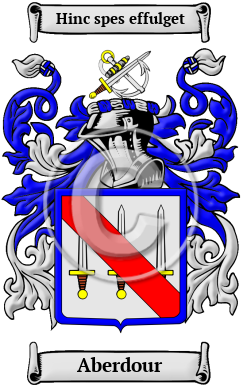
The motto was originally a war cry or slogan. Mottoes first began to be shown with arms in the 14th and 15th centuries, but were not in general use until the 17th century. Thus the oldest coats of arms generally do not include a motto. Mottoes seldom form part of the grant of arms: Under most heraldic authorities, a motto is an optional component of the coat of arms, and can be added to or changed at will; many families have chosen not to display a motto.
Motto: Hinc spes effulget
Motto Translation: Hence hope shines forth.
- Lower, Mark Anthony, Patronymica Britannica, A Dictionary of Family Names of the United Kingdom. London: John Russel Smith, 1860. Print.
- Black, George F., The Surnames of Scotland Their Origin, Meaning and History. New York: New York Public Library, 1946. Print. (ISBN 0-87104-172-3)
- Sims, Clifford Stanley The Origin and Signification of Scottish Surnames. 1862. Print.
- Lewis, Samuel, A Topographical Dictionary of Scotland. Institute of Historical Research, 1848, Print.
 |