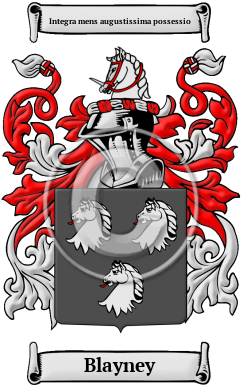
| ![Show Contents]() Blayney History, Family Crest & Coats of Arms Blayney History, Family Crest & Coats of Arms
- Origins Available:
Ireland
Wales
Etymology of BlayneyWhat does the name Blayney mean? While Blayney has long been known as an Irish name, the origins of the ancient name Blayney belong to that rich Celtic tradition that comes from Wales. This surname was derived from the Welsh personal name Blethyn. Early Origins of the Blayney familyThe surname Blayney was first found in Worcestershire, but moved to Ireland in the 1500's. Today a small village named Blaney (from the Irish: Bléinigh meaning "creeks") lies in County Fermanagh, Northern Ireland. Locals claim the area takes its name from the Irish word "Bléan" which also means a "creek." 1 Early History of the Blayney familyThis web page shows only a small excerpt of our Blayney research. Another 205 words (15 lines of text) covering the years 1570, 1573, 1602, 1603, 1604, 1629, 1646, 1689, 1802 and 1874 are included under the topic Early Blayney History in all our PDF Extended History products and printed products wherever possible. Blayney Spelling VariationsSpelling variations of this family name include: Blayney, Blainey, Blaney, Blany, Blaney, Blainay, Blanay, Blaynay, Bleiney and many more. Early Notables of the Blayney family- Sir Edward Blayney, also Blainey or Blaney (1570-1629?), Welsh soldier in Ireland who became Baron Blayney of Monaghan...
- He built the castle (using the stones of a destroyed Franciscan friary) on Lough Muckno, around which the Castleblayney village grew...
| Blayney migration to the United States | + |
Blayney Settlers in United States in the 19th Century- Richard I Blayney, who arrived in Charleston, South Carolina in 1806 2
- John Blayney, who landed in Washington County, Pennsylvania in 1808 2
- William Blayney, who arrived in Delaware in 1812
- William Blayney, aged 47, who landed in Pennsylvania in 1812 2
- Henry Blayney, who arrived in America in 1825 2
- ... (More are available in all our PDF Extended History products and printed products wherever possible.)
| Blayney migration to Australia | + |
Blayney Settlers in Australia in the 19th Century- Miss Mary Blayney, (b. 1821), aged 20, Irish house servant from Sligo, Ireland departing on 8th July 1841 from Greenock, Scotland aboard the ship "New York Packet" arriving in Sydney, New South Wales, Australia on 23rd October 1841 3
| Contemporary Notables of the name Blayney (post 1700) | + |
- Keith Blayney, American Medical educator, Dean of Indiana University
- Mrs. Dana C. Blayney, American Republican politician, Delegate to Republican National Convention from Utah, 1936 4
- John Joseph Blayney KSG (1925-2018), Irish rugby player, barrister, and jurist, Judge of the Supreme Court of Ireland (1992-1997)
The motto was originally a war cry or slogan. Mottoes first began to be shown with arms in the 14th and 15th centuries, but were not in general use until the 17th century. Thus the oldest coats of arms generally do not include a motto. Mottoes seldom form part of the grant of arms: Under most heraldic authorities, a motto is an optional component of the coat of arms, and can be added to or changed at will; many families have chosen not to display a motto.
Motto: Integra mens augustissima possessio
Motto Translation: An honest mind is the most glorious possession
- MacLysaght, Edward, Irish Families Their Names, Arms and Origins 4th Edition. Dublin: Irish Academic, 1982. Print. (ISBN 0-7165-2364-7)
- Filby, P. William, Meyer, Mary K., Passenger and immigration lists index : a guide to published arrival records of about 500,000 passengers who came to the United States and Canada in the seventeenth, eighteenth, and nineteenth centuries. 1982-1985 Cumulated Supplements in Four Volumes Detroit, Mich. : Gale Research Co., 1985, Print (ISBN 0-8103-1795-8)
- Ship Voyages to New South Wales (Retrieved 18th November 2020). Retrieved from http://indexes.records.nsw.gov.au/ebook/list.aspx?Page=NRS5316/4_4782/New%20York%20Packet_23%20Oct%201841/4_478200095.jpg&No=235
- The Political Graveyard: Alphabetical Name Index. (Retrieved 2015, December 1) . Retrieved from http://politicalgraveyard.com/alpha/index.html
 |