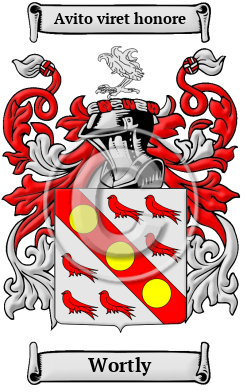
| ![Show Contents]() Wortly History, Family Crest & Coats of Arms Wortly History, Family Crest & Coats of Arms
- Origins Available:
England
Etymology of WortlyWhat does the name Wortly mean? The ancestors of the Wortly surname lived among the ancient Anglo-Saxon culture. The name comes from when they lived in Wortley, in the West Riding of Yorkshire. The place-name was recorded as Wirteleie in the Domesday Book. It is composed of the Old English elements wyrt, which means vegetable, and leah, which means forest clearing. The place-name meant "forest clearing where vegetables are grown." 1 English local names were originally preceded by a preposition, such as de, at, atte, by, in. After the Norman Conquest, the usual preposition was de, which was used in both English and French place-names. In French names beginning with a vowel, the de was often merged with the name. For example, de Ash would become D'ash and later, Dash. By the end of the 14th century, prepositions were frequently assimilated or dropped from the surname. Early Origins of the Wortly familyThe surname Wortly was first found in South Yorkshire at Wortley, home to Wortley Manor, a stately home which was rebuilt by Sir Richard Wortley in 1586. Today it is home to a group of local trade union activists that purchased the estate in 1951. Wedding ceremonies and day visitors are welcome. "This place, which had been for many generations the property and residence of the Wortley family, was, on the demise of Sir Francis Wortley, Bart., the last male heir, conveyed, by marriage with his daughter and heiress, to the Hon. Sidney Montagu." 2 Early History of the Wortly familyThis web page shows only a small excerpt of our Wortly research. Another 86 words (6 lines of text) covering the years 1577, 1579, 1583, 1592, 1611, 1652 and 1665 are included under the topic Early Wortly History in all our PDF Extended History products and printed products wherever possible. Wortly Spelling VariationsBefore English spelling was standardized a few hundred years ago, spelling variations of names were a common occurrence. Elements of Latin, French and other languages became incorporated into English through the Middle Ages, and name spellings changed even among the literate. The variations of the surname Wortly include Wortley, Wortly and others. Early Notables of the Wortly familyFrancis Wortley of Wortley, High Sheriff of Derbyshire 1577, Custos Rotulorum of the West Riding of Yorkshire, 1579-1583; Sir Richard Wortley, of Wortley Hall, Yorkshire; and his son, Sir Francis Wortley, 1st Baronet (c...
Another 33 words (2 lines of text) are included under the topic Early Wortly Notables in all our PDF Extended History products and printed products wherever possible. Migration of the Wortly familyA great wave of immigration to the New World was the result of the enormous political and religious disarray that struck England at that time. Families left for the New World in extremely large numbers. The long journey was the end of many immigrants and many more arrived sick and starving. Still, those who made it were rewarded with an opportunity far greater than they had known at home in England. These emigrant families went on to make significant contributions to these emerging colonies in which they settled. Some of the first North American settlers carried this name or one of its variants: W. Wortley settled in San Francisco in 1850.
The motto was originally a war cry or slogan. Mottoes first began to be shown with arms in the 14th and 15th centuries, but were not in general use until the 17th century. Thus the oldest coats of arms generally do not include a motto. Mottoes seldom form part of the grant of arms: Under most heraldic authorities, a motto is an optional component of the coat of arms, and can be added to or changed at will; many families have chosen not to display a motto.
Motto: Avito viret honore
Motto Translation: He flourishes through the honour of his ancestors.
- Mills, A.D., Dictionary of English Place-Names. Oxford: Oxford University Press, 1991. Print. (ISBN 0-19-869156-4)
- Lewis, Samuel, A Topographical Dictionary of England. Institute of Historical Research, 1848, Print.
 |