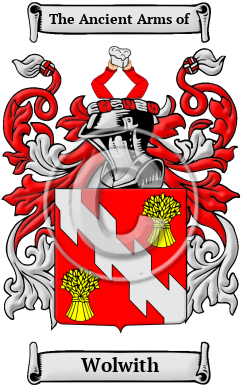
| ![Show Contents]() Wolwith History, Family Crest & Coats of Arms Wolwith History, Family Crest & Coats of Arms
- Origins Available:
England
Etymology of WolwithWhat does the name Wolwith mean? The history of the Wolwith family name begins after the Norman Conquest of 1066. They lived in Surrey, at Walworth, a hamlet, in the parish and union of St. Mary, Newington, two miles from London. 1 Now part of Greater London, Walworth dates back to Saxon times, where in 1001 it was listed as Wealawryth. By the time of the Domesday Book of 1086, it was known as Waleorde. 2 The place name literally means "enclosure of the Britons." 3 But another source claims the name meant "Welshman's farm." 4 Walworth, a township, in the parish of Heighington, union of Darlington in Durham 1 is another possible origin of the family. 5 Early Origins of the Wolwith familyThe surname Wolwith was first found in Surrey where they were Lords of the manor of Walworth from early times. At the time of the taking of the Domesday Book survey in 1086, Walworth was held by Baynard from the Archbishop of Canterbury, and conjecturally the Walworths are descended from this Baynard a Norman noble. 2 One of the first entries of the family in public rolls was John de Walworth who was listed in London in 1340. Later in Yorkshire, John de Walleworth was found in the Feet of Fines for 1375. Back in London, we found Richard Walleworth in the Assize Rolls of 1400. 5 Sir William Walworth (d. 1385) was Lord May of London and "was descended of good family. A William de Walworth, who may have been his father, was the grantee of land in Darlington in 1314. Sir William himself succeeded a member of the ancient family of Bart, Bard, or Baard, in the tenure of a manor which included the parish of Middleton St. George, near Darlington in Durham." 6 Early History of the Wolwith familyThis web page shows only a small excerpt of our Wolwith research. Another 72 words (5 lines of text) covering the years 1373, 1374, 1375, 1380, 1381, 1385, 1592 and 1750 are included under the topic Early Wolwith History in all our PDF Extended History products and printed products wherever possible. Wolwith Spelling VariationsBefore the advent of the printing press and the first dictionaries, the English language was not standardized. Sound was what guided spelling in the Middle Ages, so one person's name was often recorded under several variations during a single lifetime. Spelling variations were common, even among the names of the most literate people. Known variations of the Wolwith family name include Wallworth, Wallworthe, Walworth, Walworthe, Woolworth, Woolworthe, Wolworth, Wolworthe, Walwork, Walworke, Wallwork and many more. Early Notables of the Wolwith familySir William Walworth (died 1385), the English nobleman and politician who was twice Lord Mayor of London (1374-1375 and 1380-1381). He is best known for killing Wat Tyler during the Peasants' Revolt in 1381. His family came from Durham. He worked for a time in the Customs House under Geoffrey Chaucer. In his second term of office as Lord Mayor, Tyler and his followers entered south London, Walworth...
Another 67 words (5 lines of text) are included under the topic Early Wolwith Notables in all our PDF Extended History products and printed products wherever possible. Migration of the Wolwith familyTo escape the political and religious chaos of this era, thousands of English families began to migrate to the New World in search of land and freedom from religious and political persecution. The passage was expensive and the ships were dark, crowded, and unsafe; however, those who made the voyage safely were encountered opportunities that were not available to them in their homeland. Many of the families that reached the New World at this time went on to make important contributions to the emerging nations of the United States and Canada. Research into various historical records has revealed some of first members of the Wolwith family to immigrate North America: Hugh Walworth, aged 45; who settled in Maryland in 1774; James Walwork settled there in 1755.
- Lewis, Samuel, A Topographical Dictionary of England. Institute of Historical Research, 1848, Print.
- Williams, Dr Ann. And G.H. Martin, Eds., Domesday Book A Complete Translation. London: Penguin, 1992. Print. (ISBN 0-141-00523-8)
- Mills, A.D., Dictionary of English Place-Names. Oxford: Oxford University Press, 1991. Print. (ISBN 0-19-869156-4)
- Harrison, Henry, Surnames of the United Kingdom: A Concise Etymological Dictionary Baltimore: Geneological Publishing Company, 2013. Print
- Reaney, P.H and R.M. Wilson, A Dictionary of English Surnames. London: Routledge, 1991. Print. (ISBN 0-415-05737-X)
- Smith, George (ed), Dictionary of National Biography. London: Smith, Elder & Co., 1885-1900. Print
 |