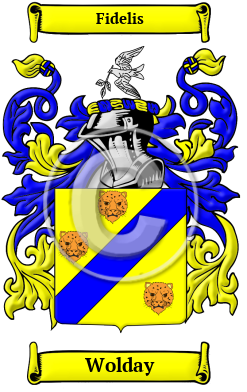
| ![Show Contents]() Wolday History, Family Crest & Coats of Arms Wolday History, Family Crest & Coats of Arms
- Origins Available:
Scotland/England
Ireland
Etymology of WoldayWhat does the name Wolday mean? The Wolday surname comes from a Scandinavian personal name, which came from the Old Norse "Valþiófr," composed of the elements "val" meaning "battle," and "þiofr," or "thief." Early Origins of the Wolday familyThe surname Wolday was first found in Roxburghshire where they had been Lords of the manor of Waldeve, near Kelso, from ancient times. 1 "This family, long settled near Kelso, co. Roxburgh, have at different times written themselves Waitho, Watho, Waltho, and Waldie. " 2 However another source notes that the family could have originated further south in England: "As Waltho or Waldie the name crept northwards into Roxburghshire, and there the surname has flourished for centuries." 3 Early History of the Wolday familyThis web page shows only a small excerpt of our Wolday research. Another 144 words (10 lines of text) covering the years 1152, 1400, 1439, 1508, 1526, 1531 and 1547 are included under the topic Early Wolday History in all our PDF Extended History products and printed products wherever possible. Wolday Spelling VariationsSpelling variations of this family name include: Waldie, Waddy, Waddie, Waldy, Waitho, Waltho and others. Early Notables of the Wolday familyMore information is included under the topic Early Wolday Notables in all our PDF Extended History products and printed products wherever possible. Migration of the Wolday family to IrelandSome of the Wolday family moved to Ireland, but this topic is not covered in this excerpt.
Another 51 words (4 lines of text) about their life in Ireland is included in all our PDF Extended History products and printed products wherever possible. Migration of the Wolday familySome of the first settlers of this family name or some of its variants were: Tho Waldie, who came to Virginia in 1649; Adam Waldie, who settled in Philadelphia in 1820; William and Isabel Crozier Waldie, who came to Ontario, Canada in 1831.
The motto was originally a war cry or slogan. Mottoes first began to be shown with arms in the 14th and 15th centuries, but were not in general use until the 17th century. Thus the oldest coats of arms generally do not include a motto. Mottoes seldom form part of the grant of arms: Under most heraldic authorities, a motto is an optional component of the coat of arms, and can be added to or changed at will; many families have chosen not to display a motto.
Motto: Fidelis
Motto Translation: Faithful.
- Black, George F., The Surnames of Scotland Their Origin, Meaning and History. New York: New York Public Library, 1946. Print. (ISBN 0-87104-172-3)
- Lower, Mark Anthony, Patronymica Britannica, A Dictionary of Family Names of the United Kingdom. London: John Russel Smith, 1860. Print.
- Bardsley, C.W, A Dictionary of English and Welsh Surnames: With Special American Instances. Wiltshire: Heraldry Today, 1901. Print. (ISBN 0-900455-44-6)
 |