
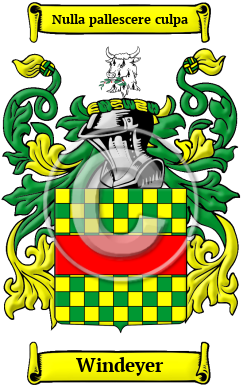
Show ContentsWindeyer History, Family Crest & Coats of Arms

Early Origins of the Windeyer family

The surname Windeyer was first found in Cumberland where they held a family seat and were Lords of the manor of Winder. This family name held considerable estates in both Cumberland and Westmorland.

Early History of the Windeyer family

This web page shows only a small excerpt of our Windeyer research. Another 90 words (6 lines of text) covering the years 1693, 1714, 1733 and 1752 are included under the topic Early Windeyer History in all our PDF Extended History products and printed products wherever possible.

Windeyer Spelling Variations

Spelling variations of this family name include: Windere, Winderes, Winder, Winders, Windhere and others.

Early Notables of the Windeyer family

Henry Winder (d. 1733), an English farmer and his son; Henry Winder (1693-1752), an English nonconformist minister and chronologist. "His grandfather, Henry Winder, farmer, who lived to be over a hundred (he was living...
Another 34 words (2 lines of text) are included under the topic Early Windeyer Notables in all our PDF Extended History products and printed products wherever possible.

Migration of the Windeyer family

Some of the first settlers of this family name or some of its variants were: Francis Winder who settled in Virginia in 1622; George Winder settled in Jamaica in 1694; Andreas and Anna Margaret Winder settled in Philadelphia, Pennsylvania in 1734.


Contemporary Notables of the name Windeyer (post 1700) +

  • Charles Windeyer (1780-1855), English-born, first reporter in the House of Lords and Australian magistrate, son of Walter Windeyer, Staffordshire 1
  • Richard Windeyer (1806-1847), English-born, Australian reformer and statesman, born in London, son of Charles Windeyer 2
  • Sir William Windeyer (1834-1897), English-born, Australian legislator and judge, only son of Richard Windeye, born in Westminster; he and his parents emigrated to Australia in 1835 2
  • Major-General Sir William John Victor Windeyer (1900-1987), Australian Officer Commanding 2nd Division Commonwealth Military Force, Korea from 1950 to 1952 2


The Windeyer Motto +

The motto was originally a war cry or slogan. Mottoes first began to be shown with arms in the 14th and 15th centuries, but were not in general use until the 17th century. Thus the oldest coats of arms generally do not include a motto. Mottoes seldom form part of the grant of arms: Under most heraldic authorities, a motto is an optional component of the coat of arms, and can be added to or changed at will; many families have chosen not to display a motto.

Motto: Nulla pallescere culpa
Motto Translation: To turn pale from no crime.


  1. Wikisource contributors. "Dictionary of National Biography, 1885-1900." Wikisource . Wikisource , 4 Jun. 2018. Web. 4 Feb. 2019
  2. Generals of World War II. (Retrieved 2011, September 8) William Windeyer. Retrieved from http://generals.dk/general/Windeyer/Sir_William_John_Victor/Australia.html


Houseofnames.com on Facebook