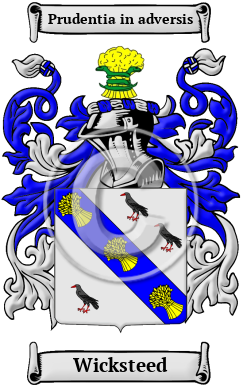
| ![Show Contents]() Wicksteed History, Family Crest & Coats of Arms Wicksteed History, Family Crest & Coats of Arms
Etymology of WicksteedWhat does the name Wicksteed mean? The name Wicksteed arrived in England after the Norman Conquest of 1066. The Wicksteed family lived in Cheshire, at the manor of Wicksted. Early Origins of the Wicksteed familyThe surname Wicksteed was first found in Cheshire where they were Lords of the manor of Wicksted from early times, and were granted the lands by William the Conqueror. Conjecturally they are descended from a Norman noble named William Malbank who held Wilkesley and Nantwich, both of which were the early Lordships occupied by the Wicksteads. Nantwich at the time of the taking of the Domesday Book in 1086 was a salt-pit and salt-pans, and Wicksted was a hawk's eyrie. Early History of the Wicksteed familyThis web page shows only a small excerpt of our Wicksteed research. Another 73 words (5 lines of text) covering the year 1795 is included under the topic Early Wicksteed History in all our PDF Extended History products and printed products wherever possible. Wicksteed Spelling VariationsA multitude of spelling variations characterize Norman surnames. Many variations occurred because Old and Middle English lacked any definite spelling rules. The introduction of Norman French to England also had a pronounced effect, as did the court languages of Latin and French. Therefore, one person was often referred to by several different spellings in a single lifetime. The various spellings include Wickested, Wicksted, Wickstead, Wickstede, Wixstead, Wixested, Wigsted, Wigstead, Whicksted, Whickstede and many more. Early Notables of the Wicksteed familyMore information is included under the topic Early Wicksteed Notables in all our PDF Extended History products and printed products wherever possible. Migration of the Wicksteed family to IrelandSome of the Wicksteed family moved to Ireland, but this topic is not covered in this excerpt. More information about their life in Ireland is included in all our PDF Extended History products and printed products wherever possible.
| Wicksteed migration to New Zealand | + |
Emigration to New Zealand followed in the footsteps of the European explorers, such as Captain Cook (1769-70): first came sealers, whalers, missionaries, and traders. By 1838, the British New Zealand Company had begun buying land from the Maori tribes, and selling it to settlers, and, after the Treaty of Waitangi in 1840, many British families set out on the arduous six month journey from Britain to Aotearoa to start a new life. Early immigrants include: Wicksteed Settlers in New Zealand in the 19th Century- John Tylston Wicksteed, aged 38, who arrived in Wellington, New Zealand aboard the ship "London" in 1840
- Emma Wicksteed, aged 31, who arrived in Wellington, New Zealand aboard the ship "London" in 1840
- Arthur Wicksteed, aged 3, who arrived in Wellington, New Zealand aboard the ship "London" in 1840
- J Tylson Wicksteed, who landed in New Plymouth, New Zealand in 1842
The motto was originally a war cry or slogan. Mottoes first began to be shown with arms in the 14th and 15th centuries, but were not in general use until the 17th century. Thus the oldest coats of arms generally do not include a motto. Mottoes seldom form part of the grant of arms: Under most heraldic authorities, a motto is an optional component of the coat of arms, and can be added to or changed at will; many families have chosen not to display a motto.
Motto: Prudentia in adversis
Motto Translation: Prudence in adversity.
 |