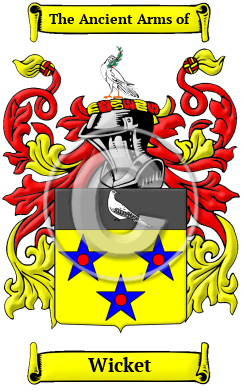
| ![Show Contents]() Wicket History, Family Crest & Coats of Arms Wicket History, Family Crest & Coats of Arms
- Origins Available:
England
Early Origins of the Wicket familyThe surname Wicket was first found in Lincolnshire where they held a family seat as Lords of the Manor. The Saxon influence of English history diminished after the Battle of Hastings in 1066. The language of the courts was French for the next three centuries and the Norman ambience prevailed. But Saxon surnames survived and the family name was first referenced in the year 1066 after the Norman Conquest when Wigot or Wigod (one of the most powerful Baron Norman origin of Bigot) from castles and lands. William Bigot was the brother of Roger Bigod and the second son of Robert Bigot became to the conquest by Apula from Italy. The name became Wiggett. Early History of the Wicket familyThis web page shows only a small excerpt of our Wicket research. Another 99 words (7 lines of text) covering the years 1185, 1284, 1455 and 1487 are included under the topic Early Wicket History in all our PDF Extended History products and printed products wherever possible. Wicket Spelling VariationsSpelling variations of this family name include: Wiggett, Wicket, Wickett, Wicketts, Wiggat, Wiggatt, Wigot, Wiket, Wyket, Vigot, Vigott, Wiggot, Wiggot and many more. Early Notables of the Wicket familyMore information is included under the topic Early Wicket Notables in all our PDF Extended History products and printed products wherever possible.
| Wicket migration to the United States | + |
Wicket Settlers in United States in the 18th Century- Danl Wicket, an emigrant in bondage on record in Potomac in 1743
| Wicket migration to West Indies | + |
The British first settled the British West Indies around 1604. They made many attempts but failed in some to establish settlements on the Islands including Saint Lucia and Grenada. By 1627 they had managed to establish settlements on St. Kitts (St. Christopher) and Barbados, but by 1641 the Spanish had moved in and destroyed some of these including those at Providence Island. The British continued to expand the settlements including setting the First Federation in the British West Indies by 1674; some of the islands include Barbados, Bermuda, Cayman Island, Turks and Caicos, Jamaica and Belize then known as British Honduras. By the 1960's many of the islands became independent after the West Indies Federation which existed from 1958 to 1962 failed due to internal political conflicts. After this a number of Eastern Caribbean islands formed a free association. 1Wicket Settlers in West Indies in the 19th Century- Richard Wicket, an English Minister, who arrived in Barbados in 1803
- Richard Wicket, who landed in Barbados in 1803 2
| Historic Events for the Wicket family | + |
Royal Charter - Mr. J. Wicket, British passenger who died aboard the ship "Royal Charter" when she sunk in a storm off the coast of Anglesey, Wales in 1859, listed with a party all lost
- https://en.wikipedia.org/wiki/British_West_Indies
- Filby, P. William, Meyer, Mary K., Passenger and immigration lists index : a guide to published arrival records of about 500,000 passengers who came to the United States and Canada in the seventeenth, eighteenth, and nineteenth centuries. 1982-1985 Cumulated Supplements in Four Volumes Detroit, Mich. : Gale Research Co., 1985, Print (ISBN 0-8103-1795-8)
 |