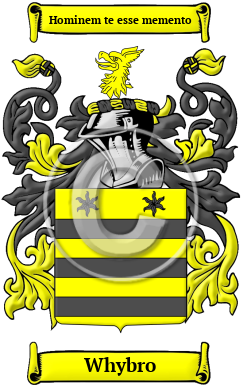
| ![Show Contents]() Whybro History, Family Crest & Coats of Arms Whybro History, Family Crest & Coats of Arms
- Origins Available:
England
Scotland
Early Origins of the Whybro familyThe surname Whybro was first found in Westmorland, where they held a family seat as Lords of the Manor of Clifton Hall. However, there is one reference of a Wybert, who was Prior of Christ Church Cathedral Priory in Canterbury, attached to Canterbury Cathedral from 1153-1167. Their family records can prove an unbroken line resident at Clifton Hall since 1367. Before the acquisition of Clifton Hall through the marriage of William de Wybergh to Eleanor, daughter and heiress of Gilbert Engayne, the family of Wybergh held a family seat at St. Bees, a parish in which Whitehaven is situated. 1 St. Bees or St. Bees Head on which there is a lighthouse, is said to have been founded by St. Bega, an Irish saint who founded a monastery there about 650 A.D. Early History of the Whybro familyThis web page shows only a small excerpt of our Whybro research. Another 105 words (8 lines of text) covering the years 1663 and 1827 are included under the topic Early Whybro History in all our PDF Extended History products and printed products wherever possible. Whybro Spelling VariationsSpelling variations of this family name include: Wybergh, Wyberg, Whyberg, Whybergh, Wyborough, Wyburgh, Whyburgh, Wyburg, Whyburg, Whybourg, Wybourgh, Wibergh, Wiberg, Wibourg, Wibourgh and many more. Early Notables of the Whybro familyMore information is included under the topic Early Whybro Notables in all our PDF Extended History products and printed products wherever possible. Migration of the Whybro familySome of the first settlers of this family name or some of its variants were: Charles M. and John Wiberg who settled in New York State in 1834.
| Contemporary Notables of the name Whybro (post 1700) | + |
- Mark Robert Whybro, Australian recipient Australian Fire Service Medal (AFSM) at the 2008 Queen's Birthday Honours (Australia)
- quadron Leader Michael John Whybro, British Royal Air Force officer, Queen's Commendation for Valuable Service in the Air Award recipient at the 1991 New Year Honours
The motto was originally a war cry or slogan. Mottoes first began to be shown with arms in the 14th and 15th centuries, but were not in general use until the 17th century. Thus the oldest coats of arms generally do not include a motto. Mottoes seldom form part of the grant of arms: Under most heraldic authorities, a motto is an optional component of the coat of arms, and can be added to or changed at will; many families have chosen not to display a motto.
Motto: Hominem te esse memento
Motto Translation: Remember that thou art a man.
- Shirley, Evelyn Philip, The Noble and Gentle Men of England; The Arms and Descents. Westminster: John Bower Nichols and Sons, 1866, Print.
 |