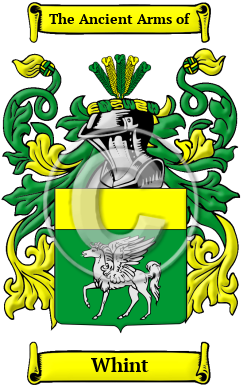
| ![Show Contents]() Whint History, Family Crest & Coats of Arms Whint History, Family Crest & Coats of Arms
- Origins Available:
Ireland
Etymology of WhintWhat does the name Whint mean? The Irish name Whint was originally written in a Gaelic form as Ó Cuinn, which means descendant of Conn. Early Origins of the Whint familyThe surname Whint was first found in county Longford (Irish: An Longfort) traditionally known as Annaly or Teffia, and situated in the Irish Midlands, in Northwest Leinster where they were Lords of Muintir Gillagain. The O'Quinns and MacQuinns (and all of the spelling variables derived from these) were descended from Conn, who in turn was descended from the Princes of Annaly. Early History of the Whint familyThis web page shows only a small excerpt of our Whint research. Another 144 words (10 lines of text) covering the years 1014, 1252, 1279, 1281, 1522, 1551, 1575, 1595, 1634, 1645, 1676, 1693, 1726 and 1766 are included under the topic Early Whint History in all our PDF Extended History products and printed products wherever possible. Whint Spelling VariationsThe Middle Ages saw a great number of spelling variations for surnames common to the Irish landscape. One reason for these variations is the fact that surnames were not rigidly fixed by this period. The following variations for the name Whint were encountered in the archives: O'Quinn, Quin, Quinn, Quine, MacQuin, MacQuinn, McQuin, McQuinn, MacCuin, Cuinn, Cuin and many more. Early Notables of the Whint familyThomas O'Quinn, Bishop of Clonmacnois (1252-1279), as well as John Quinn, Bishop of Limerick (1522-1551), as well as Thady Quin (1645-1726) of Adare of the Thomond O'Quins, who was the grandfather of the first Earl of Dunraven.
Walter Quin (c. 1575-1634), was an Irish poet and preceptor of Charles I. Born in Dublin, he travelled abroad and became a cultivated writer in English, French, Italian, and Latin. He was in Edinburgh when, in 1595, he...
Another 73 words (5 lines of text) are included under the topic Early Whint Notables in all our PDF Extended History products and printed products wherever possible. Migration of the Whint familyDeath and immigration greatly reduced Ireland's population in the 19th century. For the native Irish people poverty, hunger, and racial prejudice was common. Therefore, thousands left their homeland to seek opportunity in North America. Those who survived the journey and the quarantine camps to which they arrived, were instrumental towards building the strong developing nations of the United States and the future Canada. By far, the largest influx of Irish settlers occurred with Great Potato Famine during the late 1840s. These were employed as construction or factory workers. An examination of passenger and immigration lists has shown early immigrants bearing the name Whint: Ack Oquin, who arrived in Virginia in 1678; David Quinn, who arrived in Pennsylvania in 1685; Daniel McQuinn, who sailed to Virginia in 1716; Knogher O'.
 |