
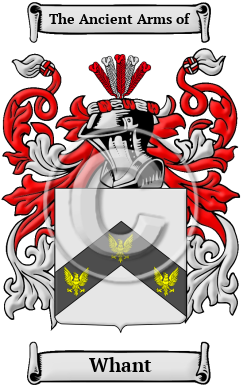
Show ContentsWhant History, Family Crest & Coats of Arms

Etymology of Whant

What does the name Whant mean?

The surname Whant was a nickname for someone who was "merry," derived from the Middle English word "wanton." 1

Early Origins of the Whant family

The surname Whant was first found in Lincolnshire where William Wantoun was listed in the Assize Rolls for 1298. Later, we found Stephen Wantoun listed in the Assize Rolls for Norfolk in 1312. 1

Further to the north in Scotland, the Wenton spelling prevailed. "Ingeram de Wenton and Thomas de Wenton were jurors at a court held at Le Bellocis Hill near Inverness, 1376-1367 (Innes Family, p. 63). Thomas Wentoun of Strikmertene, [was] a charter witness at Dudhope, 1609." 2

Early History of the Whant family

This web page shows only a small excerpt of our Whant research. Another 93 words (7 lines of text) covering the years 1455, 1487, 1568 and 1603 are included under the topic Early Whant History in all our PDF Extended History products and printed products wherever possible.

Whant Spelling Variations

Before English spelling was standardized a few hundred years ago, spelling variations of names were a common occurrence. Elements of Latin, French and other languages became incorporated into English through the Middle Ages, and name spellings changed even among the literate. The variations of the surname Whant include Wantron, Wonton, Wanton, Wantown, Wantoon, Wantune, Wandon, Wand, Want and many more.

Early Notables of the Whant family

More information is included under the topic Early Whant Notables in all our PDF Extended History products and printed products wherever possible.

Migration of the Whant family

A great wave of immigration to the New World was the result of the enormous political and religious disarray that struck England at that time. Families left for the New World in extremely large numbers. The long journey was the end of many immigrants and many more arrived sick and starving. Still, those who made it were rewarded with an opportunity far greater than they had known at home in England. These emigrant families went on to make significant contributions to these emerging colonies in which they settled. Some of the first North American settlers carried this name or one of its variants: the name represented in many forms and recorded from the mid 17th century in the great migration from Europe. Migrants settled in the eastern seaboard from Newfoundland, to Maine, to Virginia, the Carolinas, and to the islands..


  1. Reaney, P.H and R.M. Wilson, A Dictionary of English Surnames. London: Routledge, 1991. Print. (ISBN 0-415-05737-X)
  2. Black, George F., The Surnames of Scotland Their Origin, Meaning and History. New York: New York Public Library, 1946. Print. (ISBN 0-87104-172-3)


Houseofnames.com on Facebook