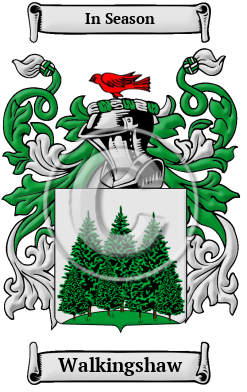
| ![Show Contents]() Walkingshaw History, Family Crest & Coats of Arms Walkingshaw History, Family Crest & Coats of Arms
- Origins Available:
Scotland
Early Origins of the Walkingshaw familyThe surname Walkingshaw was first found in Renfrewshire (Gaelic: Siorrachd Rinn Friù), a historic county of Scotland, today encompassing the Council Areas of Renfrew, East Renfrewshire, and Iverclyde, in the Strathclyde region of southwestern Scotland, at Walkinshaw the Walkinshaws of the Ilk were listed as early as 1235 and held estates at Burrowfield. Early History of the Walkingshaw familyThis web page shows only a small excerpt of our Walkingshaw research. Another 74 words (5 lines of text) covering the years 1235, 1560, 1671, 1720, 1731 and 1802 are included under the topic Early Walkingshaw History in all our PDF Extended History products and printed products wherever possible. Walkingshaw Spelling VariationsSpelling variations of this family name include: Walkinshaw, Walkingshaw and others. Early Notables of the Walkingshaw familyAnother 44 words (3 lines of text) are included under the topic Early Walkingshaw Notables in all our PDF Extended History products and printed products wherever possible.
| Walkingshaw migration to the United States | + |
Walkingshaw Settlers in United States in the 20th Century- Marion C. Walkingshaw, aged 22, who immigrated to the United States from Biggar, in 1905
- Mary Walkingshaw, aged 24, who settled in America from Olverton, Montserrat, in 1916
- Richard Walkingshaw, aged 17, who immigrated to the United States from Polmont, Scotland, in 1923
| Walkingshaw migration to Australia | + |
Walkingshaw Settlers in Australia in the 19th Century- Elizabeth Walkingshaw, English convict from Surrey, who was transported aboard the "Angelina" on April 25, 1844, settling in Van Diemen's Land, Australia 1
| Contemporary Notables of the name Walkingshaw (post 1700) | + |
- Bob Walkingshaw, American actor, known for his work in I Love You Bernie Summersby (2010), Sarah's Child (1994) and One Good Man (2009)
- Rachel Walkingshaw (b. 1994), Scottish footballer
The motto was originally a war cry or slogan. Mottoes first began to be shown with arms in the 14th and 15th centuries, but were not in general use until the 17th century. Thus the oldest coats of arms generally do not include a motto. Mottoes seldom form part of the grant of arms: Under most heraldic authorities, a motto is an optional component of the coat of arms, and can be added to or changed at will; many families have chosen not to display a motto.
Motto: In Season
- State Library of Queensland. (Retrieved 2014, November 27) Angelina voyage to Van Diemen's Land, Australia in 1844 with 171 passengers. Retrieved from http://www.convictrecords.com.au/ships/angelina/1844
 |